Information of early Chaplains and Vicars has been taken from records of the time, and therefore can often only show as being ‘known of’ in specific years.
Earliest historical date of St. Leonard’s Church Seaford, as it is not specifically mentioned in the Domesday Book.
A grand cruciform style Church with a central tower. (It is generally considered that it must have replaced an earlier Church on the same site, although there is no proof of this).
Two aisles built on either side of the nave. Rounded arches cut into the original walls.
Chaplain Peter de Blokesham known to be present at this point.
Pope Alexander confirms to the Bishop of Chichester, various properties belonging to the Cathedral, including ‘The exchange of the Church of S(e)aford for the land at Denton.’
Transformation of Church c1180 – 1200.
Bishop Seffrid II granted the Church to the common fund the resident canons, and provided 100 shillings yearly from its revenues to endow a prebendal stall in the Cathedral, the first holder being Peter de Blokesham.
Chaplain Humphrey known to be present at this point.
Transformation of the Norman Church completed.
The nave was heightened by a clerestory, some rounded arches were replaced yearly english pointed arches. Carving work completed.
Chaplain Ralph known to be present around this point.
The first mention is made of Seaford as a Cinque port, it is likely that the town was quite prosperous at this time.
Induction of Chaplain Roger de Blatchington.
Induction of Chaplain Thomas de Wycombe as Vicar
Seaford and the Church congregation, suffered greatly from the ‘Great Pestilence’.
Eastern half of the Church, and South nave aisle destroyed by fire by enemies.
The church was sacked by the French and burnt down. Only parts of the nave remained and the south wall was completely destroyed.
Vicar Roger Fynch is recorded as being ‘Late Vicar’ in this year. It is not known when he was inducted.
Induction of Vicar Walter Estoune after a ‘lapse of time’ interval.
End date of incumbency of Vicar Walter Estoune not known.
Incumbency of Vicar Thomas Parlbuen known at this point
Induction date of Vicar Thomas Parlbuen not known.
Incumbency of Vicar Thomas Parlbuen ends. Induction of Vicar Roger Ridere.
End date of incumbency of Vicar Roger Ridere not known.
Induction of Vicar Richard Crosseby.
End date of incumbency of Vicar Richard Crosseby not known.
Incumbency of Vicar William Phylypp ends. Induction of Vicar John Aston.
Induction date of Vicar William Phylypp not known.
Incumbency of Vicar John Aston ends. Induction of Chaplain William Pynson.
End date of incumbency of Chaplain William Pynson not known.
Incumbency of Vicar Ralph Gaunstede ends. Induction of Vicar William Danyell.
Induction date of Vicar Ralph Gaunstede not known.
Vicar John Marchall is known at this point.
Vicar John Marchall is still known at this point.
End date of incumbency of Vicar John Marchall not known.
Vicar Roger Hoose is known at this point.
Induction and end date of incumbency of Vicar Roger Hoose not known.
Tower Re-built
The church was restored using whatever material could be salvaged. The south wall was rebuilt and a new porch was added. A gallery was probably also added at this time at the west end of the nave. The most dramatic change however was the tower.
Incumbency of Vicar William ____ ends. Induction of Chaplain James Ball.
Induction date of Vicar William ____ not known.
St Erasmus Light bequeathed to the Church, and placed in the Tower.
The will of Richard Dumbrill in 1504 says “I bequeath the Church of Seaford a St Erasmus Light of one pound wax”. St Erasmus was a patron saint of sailors and the light would have shone from the tower towards the port.
Between 1508 & 1523, Bishop Sherbourne annexed the Church at Sutton (St. Nicholas) to the Vicarage of Seaford, although it does not appear to have become effective until 1534.
The importance of the former ‘Sutton’ parish has been reflected in the title “The Parish of Sutton with Seaford”
Vicar William Draper known at this point
Vicar William Draper took over at Chaplain James Ball’s death, but never appeared in any registers.
Incumbency of Vicar William Draper ends. Induction of Vicar John Clerke.
Incumbency of Vicar John Clerke ends. Induction of Vicar Thomas Garett as Vicar of Sutton cum Seaford.
End date of incumbency of Vicar Thomas Garett not known, but assumed as this year. The Church of Sutton was annexed to Seaford Church in this year, to become the Parish of Sutton cum Seaford.
0The first mention of the dedication of the church to St Leonard, when a man called Will Best left a will asking to be buried in the churchyard of St Leonard at Seaford. St Leonard was another patron saint for sailors and the church is one of five in the county dedicated to him – three of these being in Cinque Ports.
First record of Vicar Robert Hall.
Induction date of Vicar Robert Hall not known.
First volume of the Register of Christenings, Marriages and Burials.
Registers were unpopular at the time, so were not well used.
Incumbency of Vicar Robert Hall ends. Induction of Vicar William Legge.
Incumbency of Vicar William Legge ends. Induction of Vicar Richard Ashton.
Incumbency of Vicar Richard Ashton ends.
Induction of Deacon Robert Hide.
Deacon Robert Hide inducted as Vicar.
Incumbency of Vicar Robert Hide ends after nearly 65 years in service. Induction of Vicar Charles Hutcheson. Induction of Vicar Thos Ballowe.
Vicar Charles Hutcheson only lasted for 3-4 months before his death.

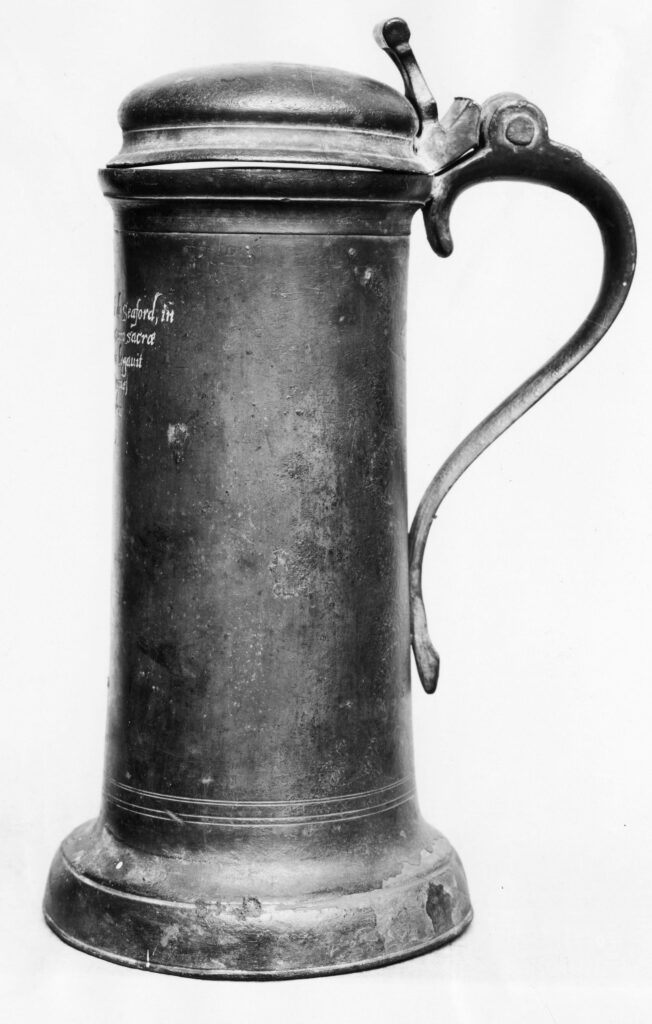
Sacramental Flagon of Pewter, bequeathed by John Beane in his will (Donated to the British Museum in 1905). Sequestration of Vicar Thos Ballowe. Minister John Saxby appointed.
Incumbency of Minister John Saxby ends.
Induction of Vicar Richard Castle.
Seaford Parish escapes the great Plague of London, with no burials recorded May – September.
Incumbency of Vicar Richard Castle ends. Induction of Vicar John Terry.
Incumbency of Vicar John Terry ends.
Induction of Vicar William Snatt.
34 year old Willam Snatt became the vicar of St Leonard’s. on the accession of William III to the throne, Snatt refused to swear allegiance to the new Protestant King. Men who refused to do this were called ‘non-jurors’.
Incumbency of Vicar William Snatt ends.
Induction of Vicar Robert Nowell.
Incumbency of Vicar Robert Nowell ends.
Induction of Vicar Robert Carr.
Sir William Barclay plotted to assassinate King William but his fellow plotters. Sir John friend and William Parkyn were caught and executed on Tower Hill. Former Vicar William Snatt attended their execution and bravely absolved them at the foot of the scaffold. He was arrested and thrown into Newgate prison but at his subsequent trial he was dealt with leniently.Add Description Here
Incumbency of Vicar Robert Carr ends. Induction of Vicar Charles Hallywell.
Incumbency of Vicar Charles Hallywell ends. Induction of Vicar Thomas Knight.
Incumbency of Vicar Thomas Knight ends.
5 Bells Re-cast. Visitation of Bishop Bowers. Parish register complete from this date.
Parish register from 1559 to this year either incomplete or missing.
Induction of Vicar John Penfold.
Incumbency of Vicar John Penfold ends. Induction of Vicar Thomas Hurdis.
62 Sailors from a French Privateer confined in the Church.
Sailors from a Swiss Privateer confined in the Church.
First Confirmation recorded in Parish register.
Incumbency of Vicar Thomas Hurdis ends. Induction of Vicar Jonathan Morgan.
Incumbency of Vicar Jonathan Morgan ends. Induction of Rev. Thomas Evans.
Chancel burnt by enemies (Most probably French).
2 coffin stones and 1 coffin (containing 16 skulls) found, and St. Michael & Dragon carving (which originally stood over the south arch of the nave), under burn site.

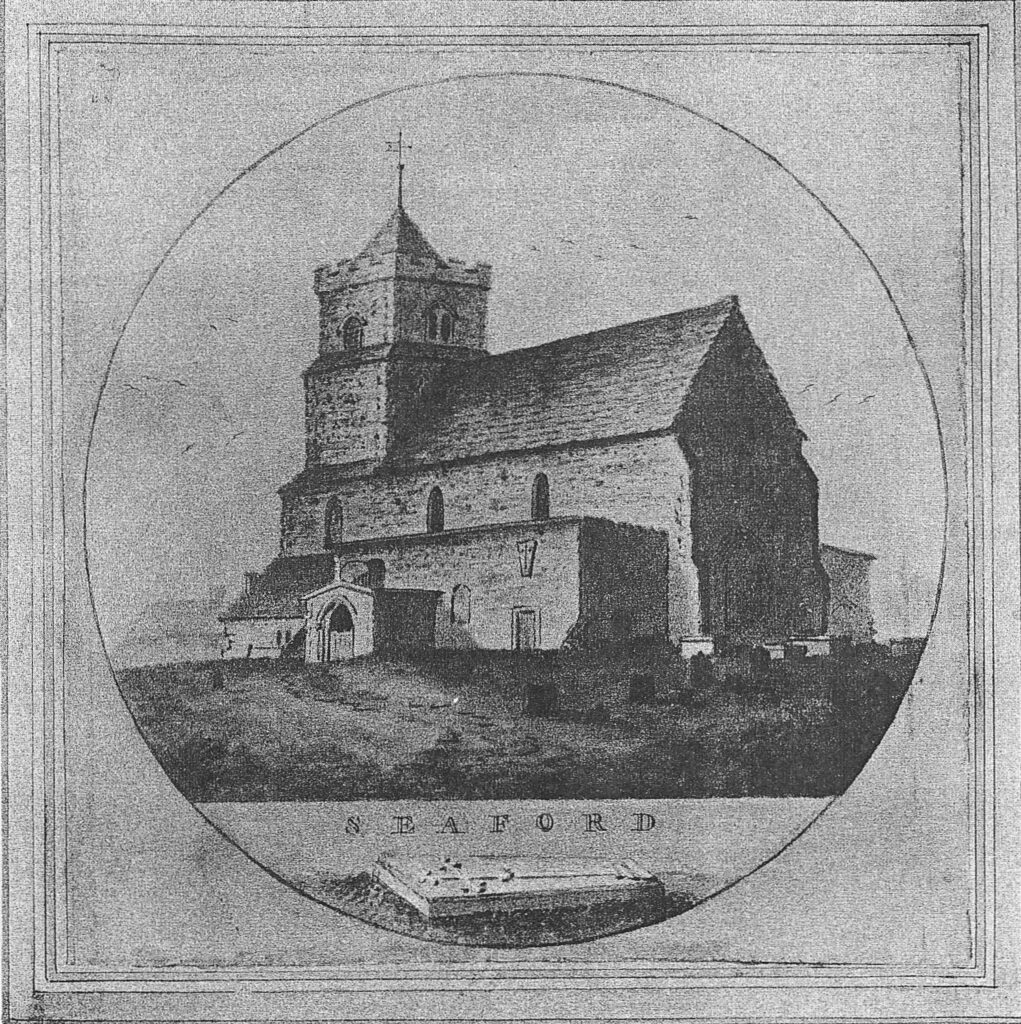
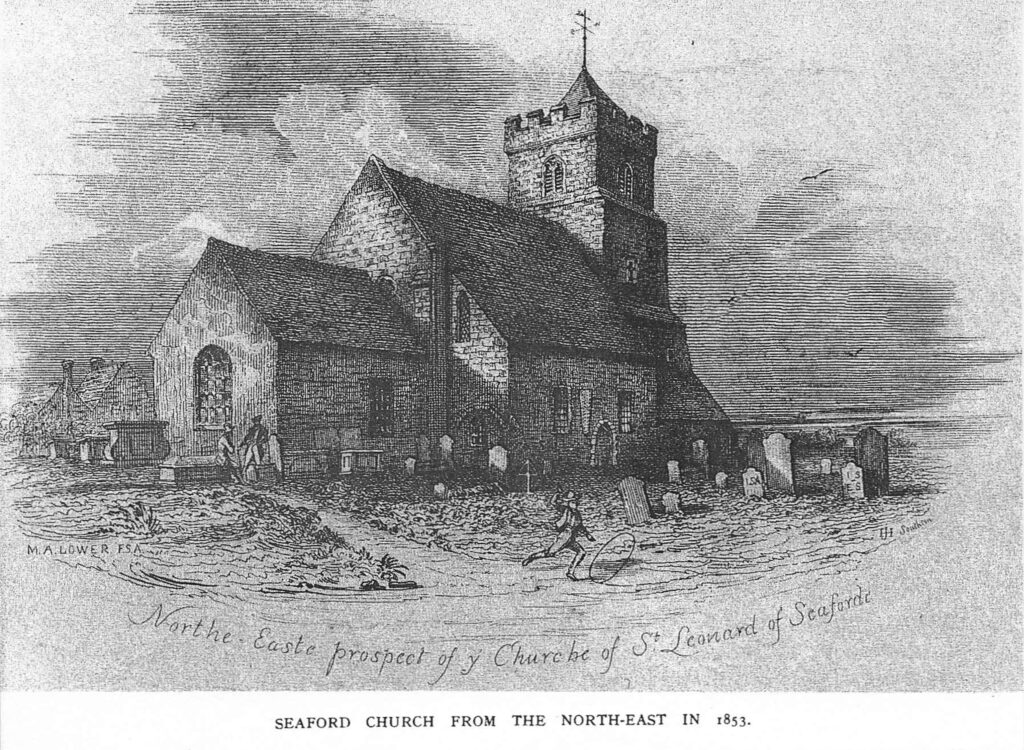
Church in 1780
South porch roof pitch sharpened. North & South roofs raised.
Gallery front was lettered and ornamented with the Royal Arms. Clock moved from East to South side.
Gallery extended across whole width of the Church.
Accessed by external stair, to west of Porch. Apparent evidence of former cruciform church discovered.


Recasting of Five Bells & increasing peal to Eight.
Opening Peal of the Eight Bells, a full 5000 changes.
Incumbency of Rev. Thomas Evans ends at his death.
Induction of Rev. William Henry Clark.
Incumbency of Rev. Henry Clark ends. Induction of Rev. Charles Edward Hutchinson.
Incumbency of Rev. Charles Edward Hutchinson ends. Induction of Rev. James Carnegie.

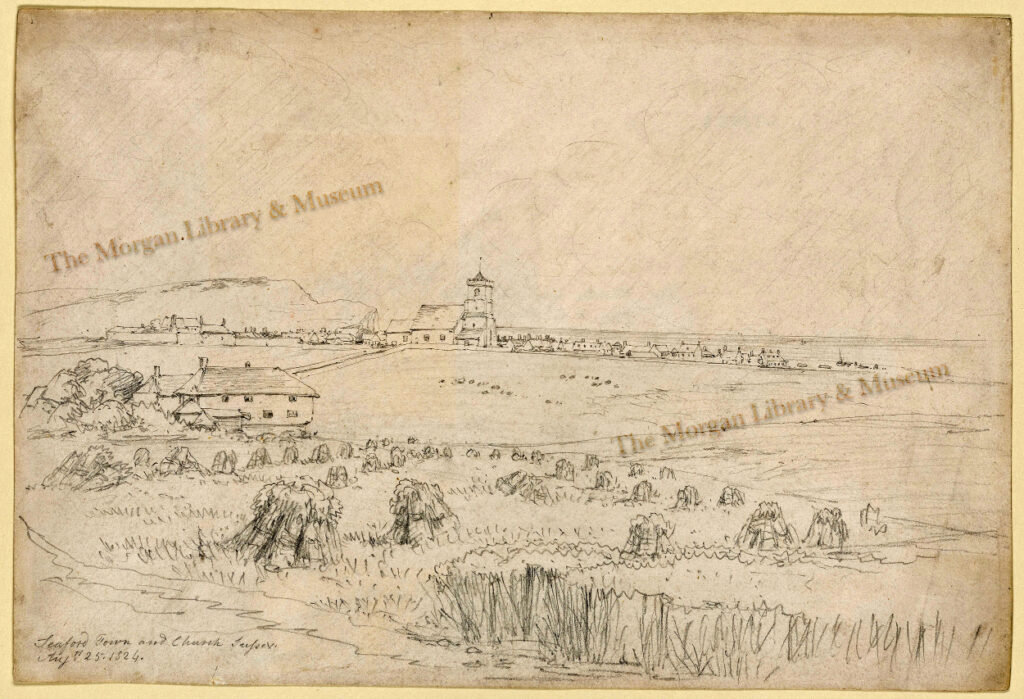
Sketch by John Constable 1824 ‘View of Seaford’. Copyright: Artist – John Constable. Title – View of Seaford, Sussex. Date – 1824. Accession number – 1969.19 Collection credit – Purchased as the gift of E.J. Rousuck. Collection item – URL https://www.themorgan.org/ drawings/item/122892
Rev W Turner Installed as Prebendary of Seaford.
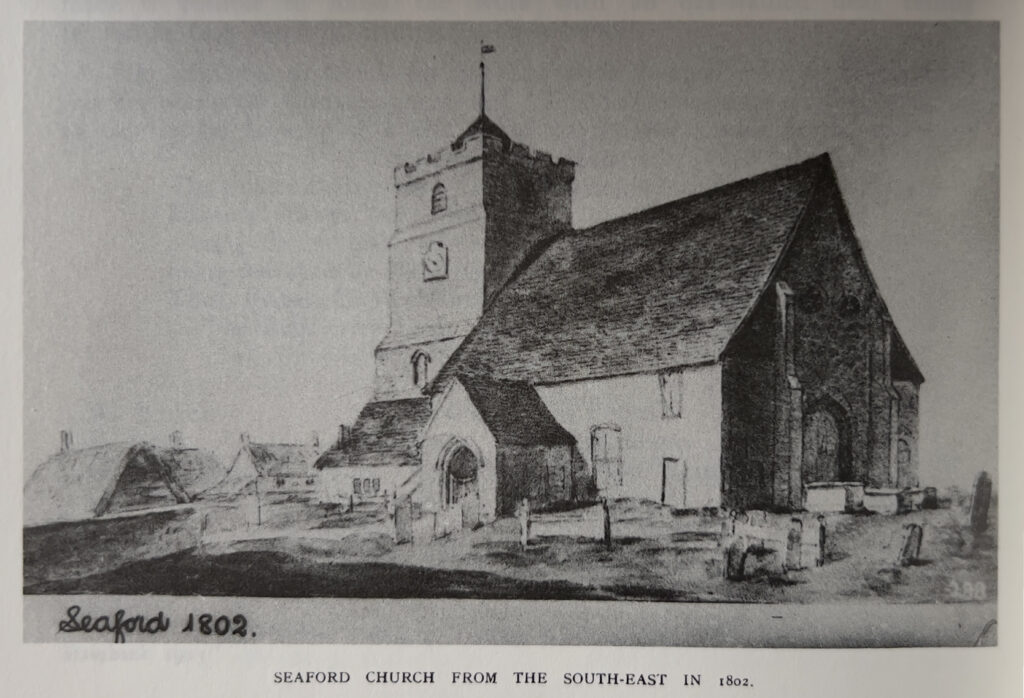
View of Church 1832
Large portions of lead were stripped from the roof by a Hurricane. 09.00am 29th November.
New Organ Erected on the Gallery. It was built by Mr W. Pilcher of Pimlico, and stood 12 feet high and 6 feet wide. It was opened on 16th August, and the organist was Mr Emanuel Horn, our first organist.
Rev James Carnegie granted a rare Faculty to become Vicar of Bishopstone alongside his being Vicar of Seaford.

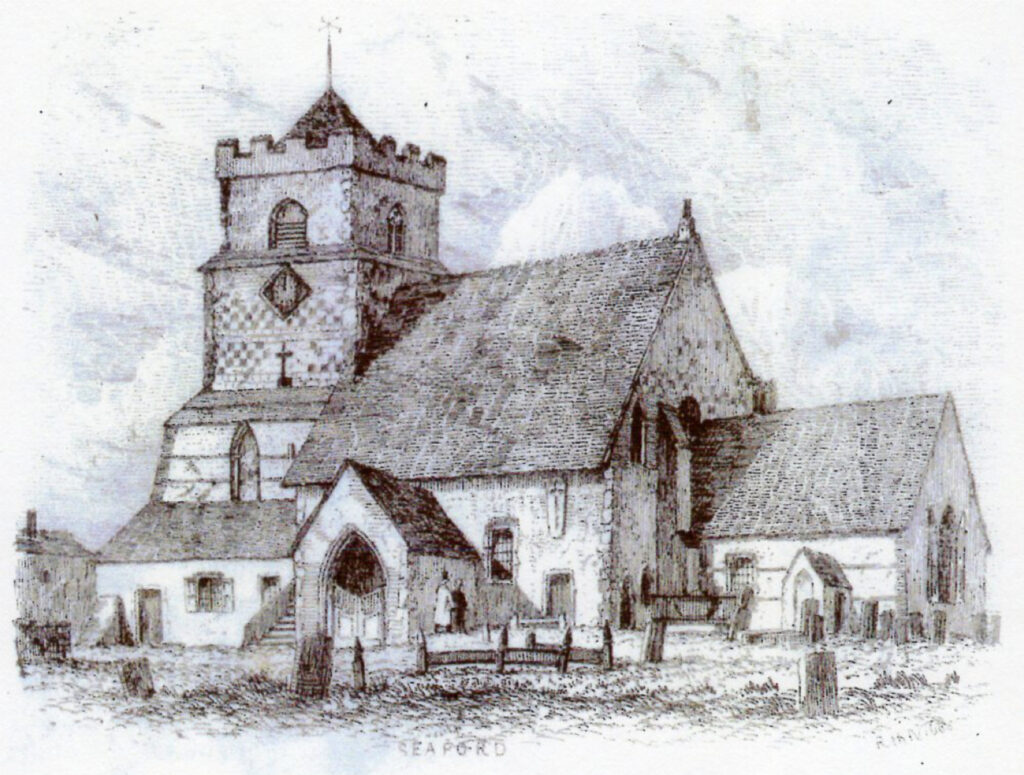
Seaford Church 1850 prior to the Victorian renovations. Note (from left to right)
• The South aisle which then extended to the west end of the church enclosing the Norman Arch which is now open to view.
• The staircase which led up to the gallery at the west end of the nave.
• The old 15th Century Porch
• The roof which extends beyond the clerestory window

9John Purcell Fitzgerald provides land for the Fitzgerald House Charity, for the Church Trust. John Purcell Fitzgerald provides funds for the new Church Schools, Foundation stone laid.
The 1860s saw a huge push by a small group of determined men led by Doctor William Tyler-Smith to ensure that the town of Seaford stayed on the map. The ‘Seaford Improvement Company’ was established and large amounts of money spent on building smart new houses, ensuring the town was protected from the sea and bring the railway to the town. St Leonard’s church was not overlooked and in 1863 a committee was established which included William Tyler-Smith, Major Harison of Sutton lodge and of course the vicar the reverend James Carnegie. Work started in 1863 and was dramatic; all of the box pews were removed as was the ceiling so that the expanse of the roof was again seen. The chancel which had been built just forty years earlier was removed and the nave extended by a few feet and a new chancel was built. The south aisle was shortened by one bay making the ancient Norman Bay an external feature as can still be seen today. The gallery at the west end of the nave was removed as was its external staircase which was just to the left of the porch. The pitch of the aisle roofs was lowered to below the clerestory windows to let more light into the church. The old fifteenth century porch was replaced by the strange “mock Tudor” design which has a black stained wood framework. It almost looks as if it is in the “Arts and Crafts” style of decoration which was to become vogue sixty years later. The floor of the church was lowered to reveal the bases of the piers and columns and lastly the whole of the exterior was re-pointed and renovated.

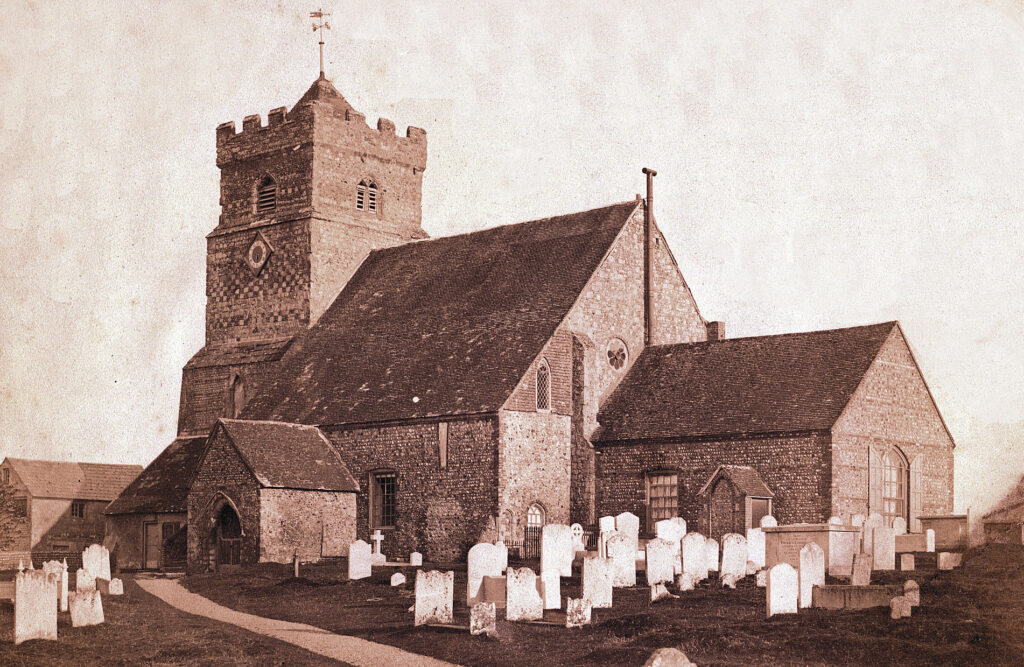
Church shown prior to restoration.
Work commences on the Restoration of the Church. J. Billing Esq. of Westminster was the Architect, and Mr Thomas Cane of Brighton the contractor.
Nave reduced by 6 feet at Eastern end.
Font basin stone ‘Disappears’.
Restoration of Church. Gallery removed. Sanctuary chairs donated. Stone Pulpit donated. Small Musicians Organ moved to South side of chancel. Church re-opened.
Stone Plaque, placed on South Elevation wall. Two roof wall tie beams added along with eastern extension. Chairs donated by James Holland Esq. Stained Deal Pulpit with elaborate carving donated by Mr H. S. Turner. Organ formerly on tower gallery.
Restoration of tower parapet.

s.Incumbency of Rev. James Carnegie ends (Died 6/2/1864). Induction of Rev. W. H. Meade Buck.
Gas Lighting added in January.
Levelling carried out on the Graves and Mounds in the Churchyard.
The Church Patronage passed into the hands of the Lord Chancellor.
Restoration of west tower window.
A large gilt cross was placed upon the communion table, raising complaints that the Church was seemingly reverting back to a Roman Catholic one.
New Clock (Still in-situ).
New Organ installed.

Sea flooding during a storm (14th November) reached the Lychgate (The Church became a temporary home for the flood refugees and their property).
Rev W. H. Meade Buck moves into the new Vicarage.
New stops added to the organ.
Subscription boxes stolen by Manchester ticket-of-leave Man.
Part of tower parapet blown down in storm, and part also removed for safety. Two Memorial windows placed in the Chancel St. John to the North, St. Paul to the South.
Resulting from the storm of 1875, the tower had to be restored and new buttresses were added. These improvements also saw the old medieval doorway at the west end of the church replaced by a new one – although nowadays this is very badly worn. New steps were added to this doorway and also a channel was dug around the whole of the church to drain off excess water.
Tower parapet restored.
Weather-vane added.
West window to tower added.
7th Bell recast.
New clock, showing Three faces.
Bell frames repaired and strengthened. New roof over the Nave, and an external drain installed around the Church.
Northern portion of Churchyard set aside by the vicar, as the burial place for nonconformists of his parish.
The system of reserved seats in Church ends, with no new reservations being taken. All current reserved seats will be free to take 5 minutes before the service starts.
In digging a grave, a gravedigger came across burnt stones at a depth of eight feet, unfortunately the coffin was lowered in before any excavation could be done, to reveal what foundations of a previous church wall were there.
A 23 foot long Kneeling mat with fine needlework for Communicants, presented by the Misses de St. Croix.
24th January, 500 Grandsire doubles rung half muffled as a tribute to his late Royal Highness the Duke of Clarence and Avondale.
First peal of Bob Major on the bells, 5024 changes. 15th July 1893.
Kneeling boards placed in the seats.
West door removed and new West door added. Completed in 1895.
Font re-positioned to West end of South aisle.
Font was formerly under Tower, and now has a reproduction basin stone to replace the one that ‘disappeared’ in 1861-62.

Lych-gate erected.
West wall set back, and road widened to align with tower.

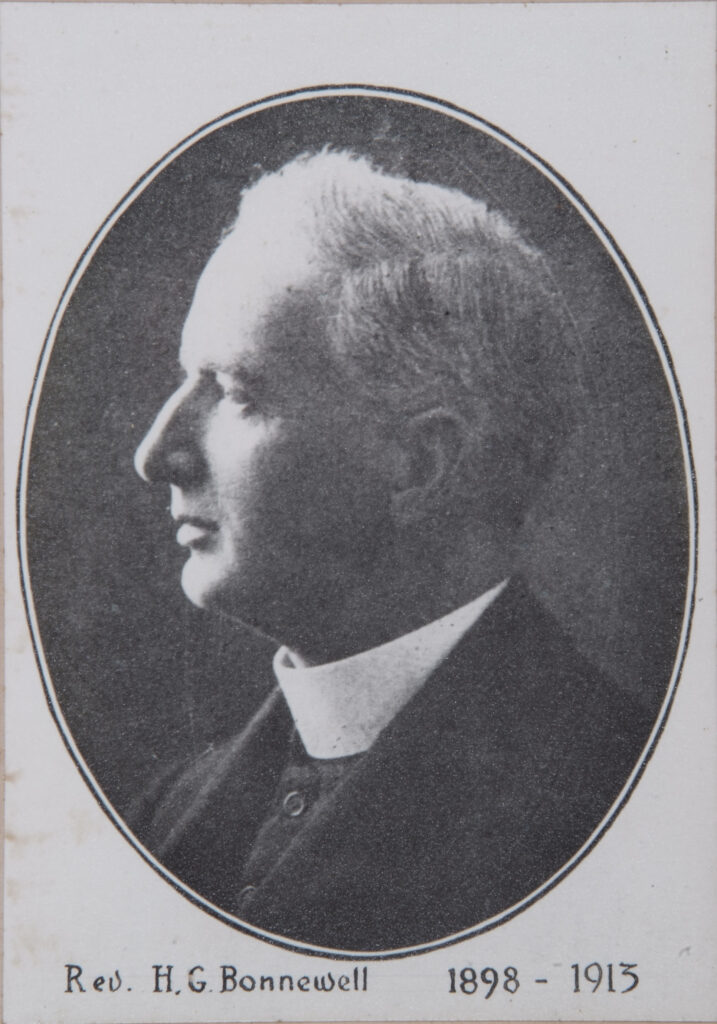
Incumbency of Rev. W. H. Meade Buck ends. Induction of Rev. Henry Goodwin Bonnewell.
Silver Alms dish donated by Mr F Eady.
The Simmons Church Institute building (newly built) was gifted to the Church.
Funeral of Rev. William Henry Meade Buck.
Faculty granted for the enlargement of the Church.
A small chapel was added to the north east corner of the church to provide extra seating for the congregation.
A Flagon, Chalice and Paton donated by Mrs Lorraine Paterson.
Memorial tablet unveiled for Cecil Richard Dashwood Winslow, and Christopher Horsley.
5th & 6th Bells recast, and whole peal rehung.
Sacramental Flagon of Pewter, bequeathed by John Beane in his will of 1642, donated to the British Museum by C. H. Read Esq.
New Organ built by Morgan & Smith, donated by Mr & Mrs James S Burroughes.
Lectern Bible presented by Miss Crawford’s Bible Class.
Processional Cross donated by the Misses Jeffries.

Incumbency of Rev. Henry Goodwin Bonnewell ends Died 4th January 1913. Induction of Rev. Frederick Daustini Cremer 5th April 1913.
New Faces to clock, and gas illumination.
Oak Panelling to sanctuary donated, and stalls added. Oak Pulpit donated.
Kingston trust donated the clock, & conditioned the town to provide gas illumination to the clock. Panelling donated by the Widow of James Samuel Burroughes. Oak Pulpit donated by Mrs Henry Simmons.
Eagle Lectern in memoriam of Rev. Henry Goodwin Bonnewell.
Adopted daughter of a Millionaire weds a soldier in secret at the Church (Miss Gertrude Langley Vanderbilt).
Lectern Bible presented in memoriam of William James Simmons (American Revision Committee version AD1901)
Maple Leaf plaques affixed to pews for Canadian troops encamped in Seaford WW1

Incumbency of Rev. F. D. Cremer ends. Induction of Rev. E. H. Phillips.
Coffin & Stone fixed to south internal wall of tower.
Agreement for the Gas Church lighting to be improved.
New peal of Bells added, along with soundproof floor.
Oak stained ceilings to the church erected.
Window dedicated to Maurice Godfrey Galloway.
Brass ewer for font donated by Mr & Mrs Harvey Trollope of Tyttenhanger Lodge.
Altar service Book donated by Miss Eckersall.
Organ chamber extended to permit a larger engine.
Electric lighting and power installed.
Seaford Toch H Banner Dedicated in the Parish Church.
Electric Duplex Rotary Blower installed by Hill, Norman & Beard.

Incumbency of Rev. E. H. Phillips ends through ill health. Induction of Rev. Charles Herbert Maxwell 12th February 1936.
J. D. Taylor, Ph.D. (Lond.) F.S.A. wrote The Parish Church of St. Leonard Seaford history book.
Oak Holy Table (dedicated to Rebecca Howe), Oak Foot Pace, Oak Frontal, Chest, White Frontal, Burse and Veil, White silk Stole and Pulpit Fall, given by Mr G. F. Howe in memory of his wife Rebecca. Mr Howe passed away a few weeks later on 6th December, aged 81.
Restoration of Tower and windows carried out. Panelling added to backs of baptistry seats.
Part of the Nave roof damaged by an air raid.
Another part of the Nave roof, and much stained glass damaged by an air raid.
Undamaged stained glass windows removed and stored for safety. Temporary plain windows put in. Final stained glass re-sited in 1958.
Part of the Nave roof damaged by an air raid.
Alms dish donated in memory of Rear Admiral E. J. Spooner, D.S.O.
Chalice donated in memory of Anthony (G.A.G.) Walker. Purificator’s donated by unknown.
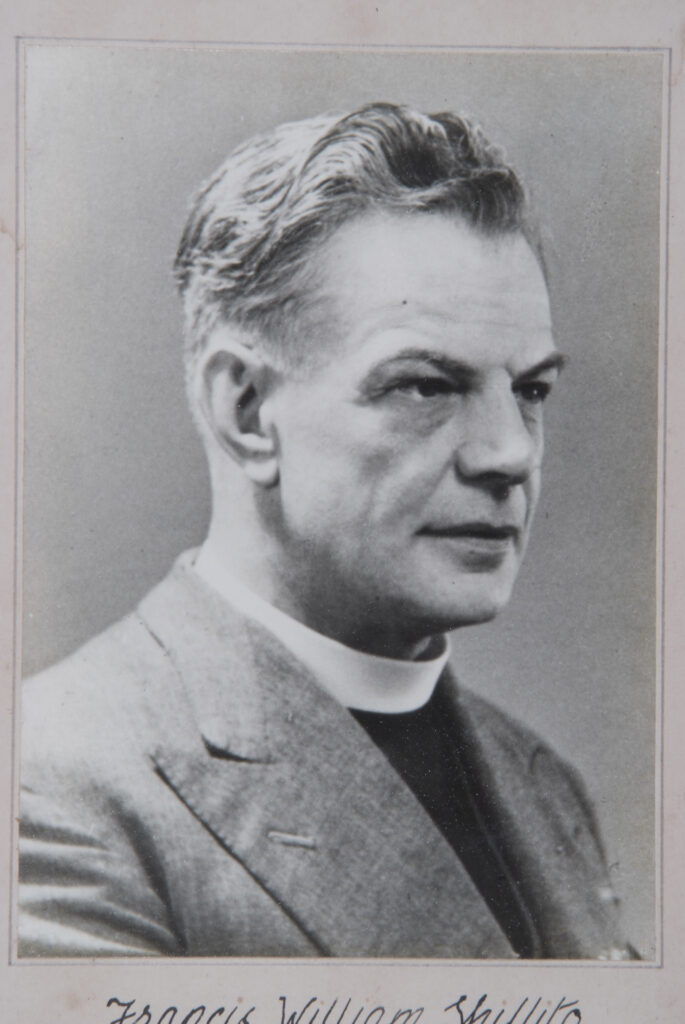
Incumbency of Rev. Charles Herbert Maxwell ends Died 17th May 1947. Induction of Rev. Francis William Shillito.Two Stained Glass windows dedicated to Rev. James Carnegie & Colonel Harrison (taken down after the air raid) re-installed.
Paton donated in thanks for the safe return of Major D. H. Maxwell. Flagon donated to complete the communion set marked 1824 (described by Dr. Taylor) in memory of Mrs Wood.

Incumbency of Rev. Charles Herbert Maxwell ends Died 17th May 1947. Induction of Rev. Francis William Shillito.
Wrought iron gates installed in the Place Lane entrance.
Organ cleaned & overhauled by Hill, Norman & Beard.
Oak screen between the Chancel and North Chapel completed, in remembrance of Rev. Charles Herbert Maxwell.
The Church was Grade I listed on 2nd March 1950.
A photo of the Church covered in snow appears on the National Savings Christmas Card.
Ciborium donated in memory of Seaford Ladies College 1900 – 1953.
St. Luke’s Church is initiated, to cater for the increased number of Church members in the Chyngton area.
Wafer box donated in memory of Herbert Wentworth Dawes.
Churchyard becomes a Closed Churchyard (No further burials allowed) and is taken over by Seaford UDC.
A prayer book of King James 11’s reign dated 1686, bound up with a bible, given by Miss D. Synge.

Incumbency of Rev. Francis William Shillito ends. Induction of Rev. Michael John Nott.
St. Luke’s foundation stone laid.
Altar furnishings donated by the Widow of Rev. F. W. Shillito.
New base for lectern donated.
Mr. T. W. H. Ringrose retires as Organist.
The old Standard of the Seaford British Legion Women’s Section was committed to the Parish Church for Safe keeping evermore.
St. Luke’s Church opens 10th June.
Oil fired boiler installed to replace the solid fuel one, a bequest from Mr Albert Simmons (Parish Clerk for over 60 years), upon his death in 1958.
Brian Richards takes over as Organist.
Clock repaired. Seaford UDC contributed to the clock repairs.
Silver cross and candlesticks donated by the Widow of Mr G. Pearson.
Ciborium donated in memory of Wilfred and Dorothy Barwell.

Incumbency of Rev. Michael John Nott ends. Induction of Rev. Ivor Colin Docker.
Clock illumination converted to electricity.
The processional cross re-silvered and a baptismal shell donated in memory of Mrs Kemp.
Organ rebuilt, and side case replaced by a grille to improve the sound. Work carried out by Hill, Norman & Beard.
Red curtains provided across the Chapel door by Mrs Gibson and her two Brothers, in memory of their Mother Mrs Maxwell.
Choir Vestry reorganised.
A set of gold riddle curtains given by Mrs Egan in memory of her husband. A cope to match the curtains, given by Mrs Brewer in memory of her husband. A white altar frontal and improvements to the sanctuary lighting, given by Mrs Adkin in memory of her husband.
North Chapel converted to The Chapel of the Holy Spirit.
Seaford UDC gave the book of remembrance to the custody of the Church, along with a display case.
Sanctuary carpet donated from the legacy of Miss Goodwin.

Incumbency of Rev. Ivor Colin Docker ends. Induction of Rev. Lewis Hawkes Roper.
The Church wall adjacent to Church Street was listed Grade II on 26th October 1971.
Portable wooden font donated by Mr Hugh Leonard.
Seaford UDC passed the responsibility of the Churchyard to Lewes DC following the change in local government.
Amplifier installed for sound system.
Gas fired boiler installed to replace the oil fired one, after it sprang a leak.
.
Organ electrics overhauled.
The old Constitutional Club purchased as a new Church Hall, first used on 16th May 1976 (The Simmons Institute was sold to help fund the purchase).
Mr Denis Wheeler Chairman of Lewes District Council pays half of the costs to Repair the Church Clock. Seaford Rugby Football Club pay the other half of the costs.
Damage to a Church window cost £250 to repair.

Incumbency of Rev. Lewis Hawkes Roper ends. Induction of Canon Michael Reginald Thompson.
North & West Churchyard walls rebuilt by Lewes District Council.
Aumbry donated by the congregation. Aumbry lamp in memory of Father Peter Dale.
Tungsten Halogen lamps installed to double the lighting power.
Piano purchased as a memorial to Mr Cecil Coram.
Bells overhauled, and headstocks & clappers renewed, from the 1958 bequest of Mr Albert Simmons (Parish Clerk for over 60 years).
Green altar frontal donated in memory of Mr T. Brookbank.
Ciborium donated in memory of Ted Pettitt.
The Great Storm caused heavy damage to the roof. Roof repairs took one year to finish.
Four Sussex Women ordained as Deacons in the Church. The First year this has been allowed following the Deanery Synods ruling.
Clock repaired (Lewes District Council Contributed to the clock repairs).
Organ cleaned & overhauled by Hill, Norman & Beard.
Churchyard becomes a recognised amenity area, and new pathways installed by Lewes District Council.
Severe gales caused damage to roof and organ (by way of leaks).
The south walls were repaired following damp problems, along with further work done to the west doorway. Work completed in April 1993.
Incumbency of Canon. Michael Reginald Thompson ends due to ill health.

Induction of Rev. Hugh Atherstone.
Rev. Elizabeth Davies arrives as the first Female Curate of the Parish 12/02/95.
A Golden Flesh self pollinating Holly tree was planted in the Churchyard on 19th February to commemorate 100 years of the WI
Great Organ Trumpet installed.
The Church was closed for Re-Ordering.
Incumbency of Rev. Hugh Atherstone ends.

Induction of Rev. Paul Owen.

Paschal Candle to match the new altar & Font installed at the Re-Ordering, donated by Mrs B. & Mr T. Willer.

Incumbency of Rev. Paul Owen ends. Induction of Rev. James Hollingsworth.
Tower roof repaired, and Weather Vane refurbished.
Chapel being sectioned off.
Kitchen and toilet areas being installed.