
The 1950s
The Chyngton Area of Seaford in the 1950s, saw a need for the building of houses and roads, which in turn saw the area grow quite rapidly.
This influx of population resulted in a need being felt for a building for the care and welfare of the community – a place where residents of the area could gather, and get to know one another.
The idea of a mission hall was born. It would be an all-purpose building with a kitchen, toilets, store and two changing rooms. It was advised that this hall would cost probably about £12,500.
Chyngton was asked to try to help raise some of the money by loans of £200, interest free, for two years. It was also suggested that at some future date the hall could be made more suitable for worship, by an extension or adaptation of the hall.
The Finance Story
As far in the past as 1937 it had been discussed that a hall could be built in the Alfriston Road area.
The vicar and churchwardens of St. Leonard’s Church met the Council Surveyor. The scheme was approved, and a site purchased for £200. However, when war broke out in 1939, no building project for this site could be considered, so nothing further was done until after the war.
When the war ended in 1945, enquiries were made for a temporary prefabricated building, but no finance was available, so no further action was taken.
In 1949 the site in the Alfriston Road area which had been bought for £200 was sold for £375, owing to the fact that a town planning scheme was being drawn up for that area for more housing
However further postponement occurred, due again to finance.
Also the Diocese felt unable to give financial backing or approval for the plan at that time.
Another alternative site was offered by Mr. Victor Bravery (a prominent Seaford resident) but the offer of the site was rejected as being unsuitable.
In 1954 Seaford U.D.C. offered a half-acre site on the newly developed Chyngton estate. This offer was accepted by the Church Commissioners in this area and known as Sutton-cum-Seaford Plans were drawn up by Mr. J. L. Denman P.P.R.I.B.A., an architect of high repute, and the addition of a church to be added later when funds permitted. Tenders were invited from Seaford firms, but the well-known building firm of the Morling family felt unable to offer a tender. Eventually the tender from Mr. Keith Andrew of Worthing was accepted.
The Diocese made a grant of £5,000 and a loan of £5000, repayable over ten years. The parish was to be responsible for a further £3,000 and also for the cost of furnishing. The final cost to complete the building as a dual-purpose hall and church was £15,791. The debt was cleared by the end of 1963. Fund raising events such as summer fetes were organised and the moneys raised went into St. Luke’s Fund. It was a very commendable effort from the residents of the Chyngton estate.
Special Dates and Celebrations of the Hall and Church
1955 The dual-purpose hall was initiated by the Revd. Francis William Shillito, MA, Vicar of St. Leonard’s Parish Church of Seaford. There is a board on the wall inside the porch door inscribed with the above.
1958 On November 8th a stone was laid, set into the outside wall of the tower with the inscription:-
A * M * D * G
THIS STONE WAS LAID BY
THE RIGHT HONOURABLE
THE LORD McCORQUODALE
OF NEWTON. P.C.
8 NOVEMBER 1958
Ad majorem Dei gloriam (AMDG) is Latin for “To the greater glory of God”. Lord McCorquodale was Chairman of the Diocesan Finance Committee.
The day was one of brilliant sunshine still remembered by a few members of today’s congregation. However the name inscribed on the tower is not truly correct! Lord McCorquodale was unable to come on the day, because of illness. A substitute officiated at the last minute!
Now to 1959 for the ‘Opening’ of the Church
St. Luke’s Church was completed and dedicated on the 10th June 1959. A plaque inside the porch says:
Parish of Seaford
St. Luke’s Church Hall, Chyngton
Initiated in 1955 by the
Reverend Francis Shillito MA
completed in 1959 by the
Reverend Michael John Nott BD AKC
dedicated on 10 June 1959
by The Lord Bishop of Chichester
The Right Reverend Roger Plumpton Wilson DD
On the day of dedication a number of the congregation from the Parish Church of St. Leonard came to the service, limiting the space available for Chyngton residents. This was perhaps slightly unfortunate, but also admirable that so many people wanted to be present.
The grand opening took place with a Guard of Honour of Guides and Scouts from St. Leonard’s – a splendid scene of young people participating. A most important factor also was that the Sunday School, already established in the hall, now had a church of their own to come to – How about that for Chyngton estate!
Description of some details between 1955 -1959
At the Chyngton Primary School, Saltwood Road, a Sunday School had been opened by a resident of the area, Mrs. Audrey Moore and organised by the Vicar. It was a very successful venture, numbers reached to 200 children, as well as a separate bible school for adults. Eventually the Sunday School was moved to St. Luke’s Church and relays of children were divided into age groups. Permission for the use of the school building had been obtained from the Church of England authorities, and a Church Committee consulted.
Therefore, in 1958 the Sunday School was well established in the School before the church was completed and dedicated in 1959.
In time, the Sunday School and crèche met downstairs, during services.
The Ship Halfpennies Fund
The Sunday School in the hall contributed to this project. The children collected £9 of halfpennies – quite a considerable sum in those days.
What was the Fund? St. Nicholas Church in Brighton collected strips of halfpennies (which had at that time a ship on one side of the coin, and these were given to the diocese for annual distribution to any church in need. St. Luke’s Church was included.
The wooden altar table was paid for by the Ship Halfpenny Fund.
The same wooden table, slightly altered, is still in the sanctuary of St. Luke’s.
The Church’s beginning had, of necessity, a lot of ‘make-do’
The altar, as already mentioned, was obtained by the Ship Halfpenny Fund. The pianist was paid £5 per year. Brian Adams was happy to play the piano until 1970. Further economies included surplices obtained second-hand, as were also the hymn boards.
There were two bench seats for the choir.
The piano was later on replaced by a harmonium; and then a small organ was installed costing £1,000, the money having been raised in three weeks. The organ’s loud speakers were fixed into the two cinema projector slots previously used by the hall. The projectors and loud speakers were situated upstairs in the vestry of the tower.
Some interesting facts within the early years of St. Luke’s.
In 1965 the Downs Girls’ School, Seaford, closed to join the Roedean School in Brighton. Miss Pitts, the headmistress, gave a lawn mower to St. Luke’s; it had a seat and a starting handle! We wonder where that mower is now, or whether it has disappeared forever.
In 1966 there was a catastrophic collapse of a colliery spoil tip in Aberfan Wales. 116 children and 28 adults were engulfed, and sadly lost their lives. St. Luke’s Sunday School like many other groups across the nation, raised money for the disaster fund. As a memorial to the money raised, three trees were planted on the corner of Walmer Road and Saltwood road.
In 1977 it had been hoped that a bell would be installed in the tower, but sufficient funds were not available. Instead a cross was placed on top of the tower. This is illuminated at night.
In 1982 the discovery was made at a funeral service that the coffin could not be carried through into the church. The two porch doors proved to be too narrow. This was rectified by both main doors being widened. Mr. H. Leonard, RIBA (now a retired architect), designed the two new doors, and also the grille over the organ.
There is a plaque dedicated to Geraldine MacGarvie who died in 1982, and contributed valuable work as a Scout leader, starting Cubs and Scouts at St. Luke’s.
In 1984 central heating was installed, replacing the old high level electric heaters.
An unusual structural feature of St. Luke’s Church
Instead of the usual custom of an eastern position for the altar, it had to be placed at the west end, or very slightly southwest! The reason for this problem was that originally a further building adjoining the tower was to be built for the church, but again finance was against this addition. Since the eastern end of the hall contained the stage, the altar had to be at the west end.
Nowadays when the church is used as a hall, the Sanctuary is hidden by folding doors. These four doors open and shut in a concertina manner.
2003 St. Luke’s house was completed, for the incoming Curate. Previously there had been a house further down Chyngton Gardens, but a house adjacent to the Church made more sense. When the Church was first built, it had been the intention to extend the Church across that area, which would then have been able to utilise the Altar at the correct Eastern end.
2006 The Church facilities were upgraded by the completion af an Annexe building. This Annexe provided the Church with a much improved Kitchen area, Toilet suitable for the dissabled as well as baby changing area, and a space that could be divided into two small rooms as well as enlarging the main hall space.
The story of St. Luke’s Church garden
In the beginning the corner plot facing both Walmer Road and Saltwood Road was just a rubbish tip. Residents living on the estate of Chyngton were able to walk across where the church tower now stands. There was no fence and no grass. A retired man levelled the ground over an entire summer.
Eventually, a wire fence surrounded the area; later a hedge was planted, which became a mature and thick escallonia hedge. At times it produces pink flowers as a bonus, and was lovingly kept cut and tidy by members of the church, before a gardening contractor was appointed.
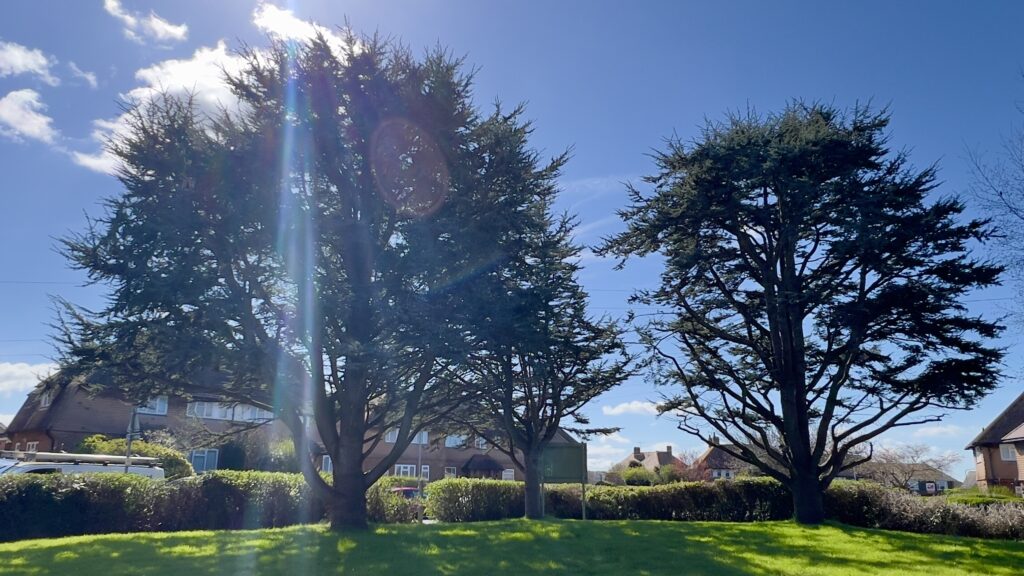
Grass was sown, and trees planted, so the corner plot gradually matured in greenery. There are also flowering trees, two of cherry, two or three wild cherries, a laburnum tree, red currant bush, and I believe a castor oil bush! A big May tree to the right of the church flowers with an abundance of red blooms during its season.
There is a story about this May Tree: the tree is thought to be in memory of a gardener, who loved to look after the church grounds.
He died in October 1967. The gardener was found lying on the grass in the corner, near where the notice board of the church now stands. On the morning of the gardener’s death a little boy of about five years old found the gardener on the ground. He ran home to his mother and said “God has struck a man in the garden”. This story is of course a sad event, but when one comes to think about the incident now – how appropriate that this man died working in the garden he loved, and for the benefit of the church.
Today there is also a narrow bed of rose bushes planted along the front of the church; some have been placed there in memory of loved ones. As one walks up the path towards the church porch in the springtime, it is good to pause, and look down at the daffodils in their beauty.
It is also good, when one walks towards the corner of Walmer Road and Saltwood Road, to look up at the tower, where the cross points towards the sky. When darkness comes in the evening the cross is floodlit; it is perhaps a ‘sign’ for us all that God loves us. He forgives us for our sins, if we have the courage and faith to ask Him. May the light of the cross continue to send its beam flowing over Chyngton.
2025 The rear garden area was updated to make it more user friendly, by levelling the area, and introducing a ramped access.

Curates of St. Luke’s.
1959 Philip Jones
1960 Donald A. A. Brett
1965 Richard M. Sweet-Escott
1972 Michael R. Pope
1976 Frank Fox-Wilson
1979 Michael C. Judge
1981 Mark W. Thomas
1984 David Gibbons
1987 Geoffrey Daw
1991 Graham J. Whiting
1995 Elizabeth J. Davies
1998 Nigel F. Mason
2003 Christine Doherty
2009 Colin Rudge
2016 Derreck Lee-Philpot (Associate Vicar)

