
Wall plaque on the south wall of the nave outside.
By 2020 it had become illegible.
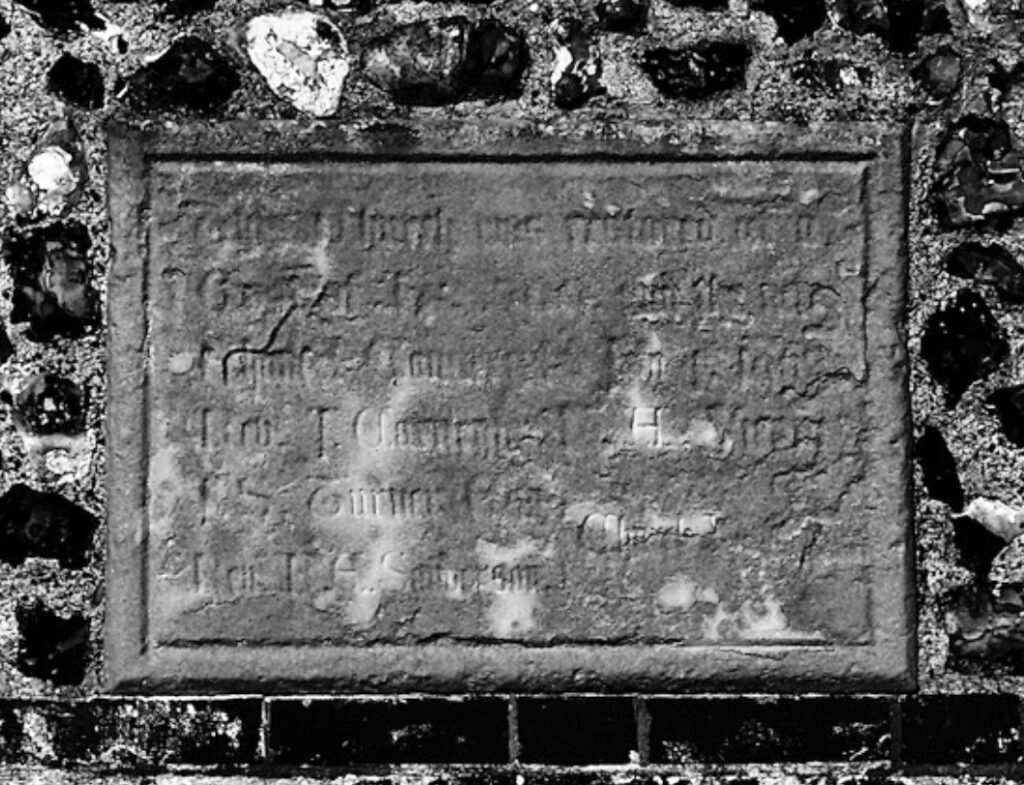
This Church was restored at a
Cost of £2500 and the new
Chancel Consecrated July — 1862
Revd. J. Carnegie M. A. Vicar
J. S. Turner Esq.
Revd. R. E. Sanderson. Church Wardens.
The Victorian Improvements
Nowadays the Victorian zeal for improving churches is often criticised for destroying much of the fabric of man ancient churches although to be fair many of these churches were in a poor state and would have collapsed without their intervention. This could not be said for St Leonard’s as the Rev. Evans had ensured that the church was renovated and kept up to date.
The 1860s saw a huge push by a small group of determined men led by Doctor William Tyler-Smith to ensure that the town of Seaford stayed on the map. The ‘Seaford Improvement Company’ was established and large amounts of money spent on building smart new houses, ensuring the town was protected from the sea and bring the railway to the town. St Leonard’s church was not overlooked and in 1863 a committee was established which included William Tyler-Smith, Major Harison of Sutton lodge and of course the vicar the reverend James Carnegie.
Work started in 1862 and was dramatic; all of the box pews were removed as was the ceiling so that the expanse of the roof was again seen. The chancel which had been built just forty years earlier was removed and the nave extended by a few feet and a new chancel was built. The south aisle was shortened by one bay making the ancient Norman Bay an external feature as can still be seen today.
The gallery at the west end of the nave was removed as was its external staircase which was just to the left of the porch. The pitch of the aisle roofs was lowered to below the clerestory windows to let more light into the church. The old fifteenth century porch was replaced by the strange “mock Tudor” design which has a black stained wood framework. It almost looks as if it is in the “Arts and Crafts” style of decoration which was to become vogue sixty years later.
The floor of the church was lowered to reveal the bases of the piers and columns and lastly the whole of the exterior was re-pointed and renovated.
The Church underwent another reordering, August to December 2006, making the Church light, airy and adaptable, as can be seen today.