
Church Plan
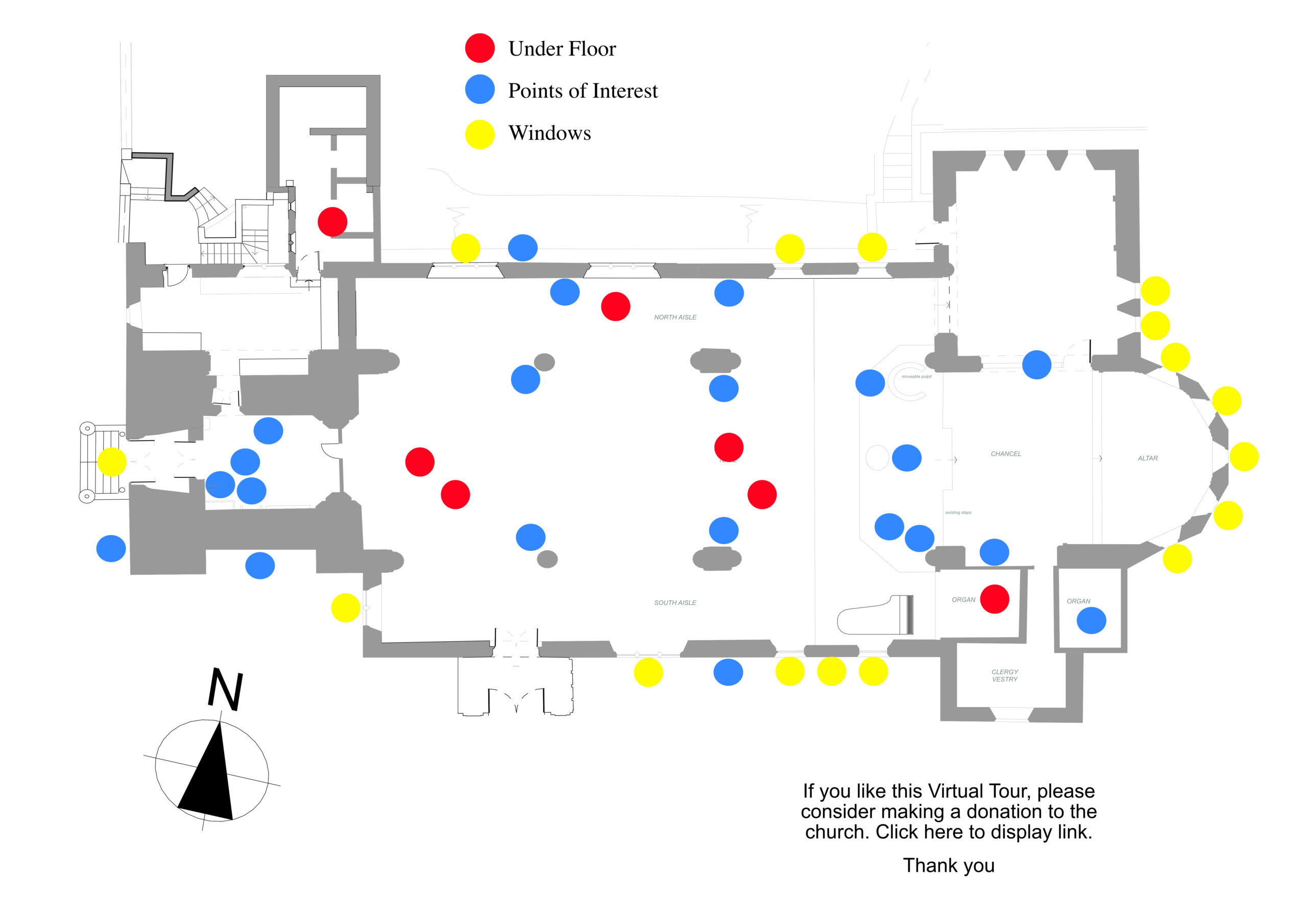
Click the points of interest for information.
Information will be displayed here.
Best Viewed in Landscape on a Mobile Phone.
Whilst the information on this site has been compiled from historical documents and published historical research, we are aware that new (clarifiable) information does sometimes come to light. Should you be in possession of such documented information, we would welcome this, in order to ensure that we have the correct records to pass on to future custodians. Please email relevant information (Subject: History) to our main Church website:- https://seafordparish.org.uk
The majority of the photography on this site is subject to copyright, please contact the webmaster (or Parish office), for usage guidance if required.
Window 1
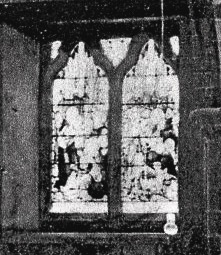
This Window was destroyed by an Air Raid in WW2.
View recovered from a Postcard of the Church interior. This is very grainy, due to the very small size within the postcard view, and being enhanced to attempt to pick out the detailing.
The Left hand Window was a Memorial to the Reverend Evans (Vicar of this Church from 1785 to 1815), and was a depiction of “The Presentation in theTemple”-Joseph, the Virgin, Child Jesus and aged Simeon.
The Right hand Window was a Memorial to John Harry Evans and Mary Evans his Wife, and Thomas their Son, and was a depiction of “Christ blessing little children”.
Window 2
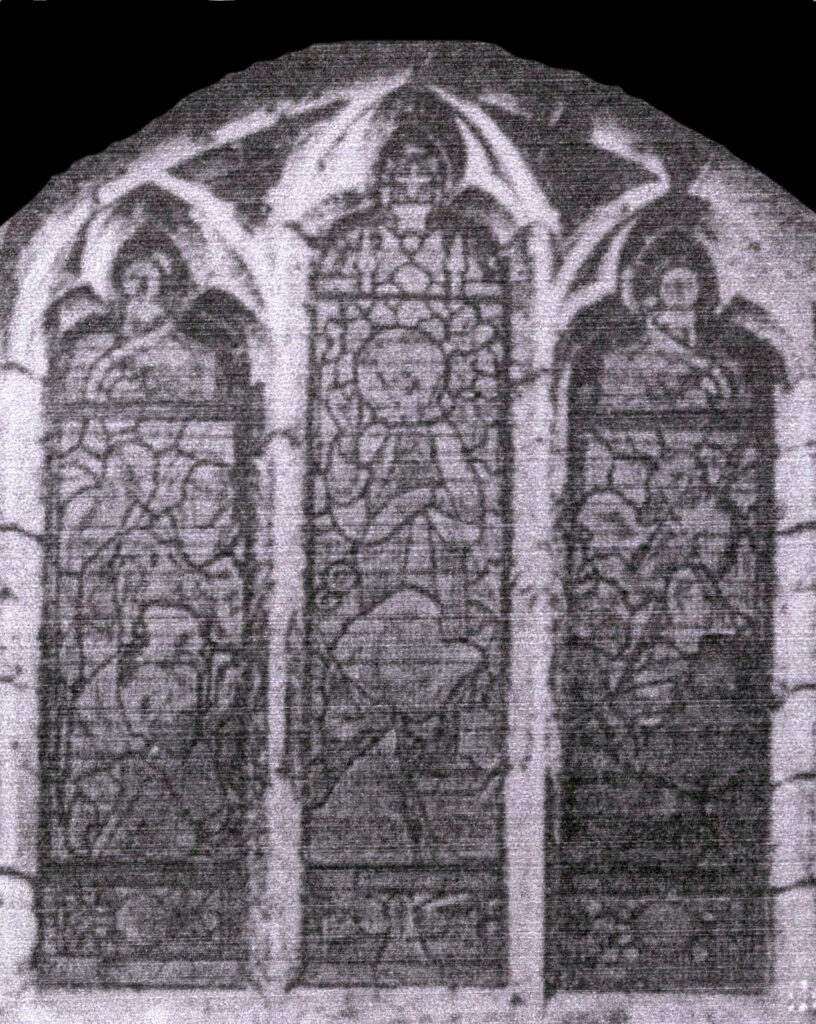
This 1886 Window, “Our Lord Healing the Sick”, was lost in a WW2 Air Raid.
It was in Memory of Henry Bean Gorring, and of Mary his Widow.
As there is not an image available taken from inside the Church, we have reversed an exterior image, in order to see some of the detailing. This means that the stone features do not appear to look the same as your viewpoint.
Window 3
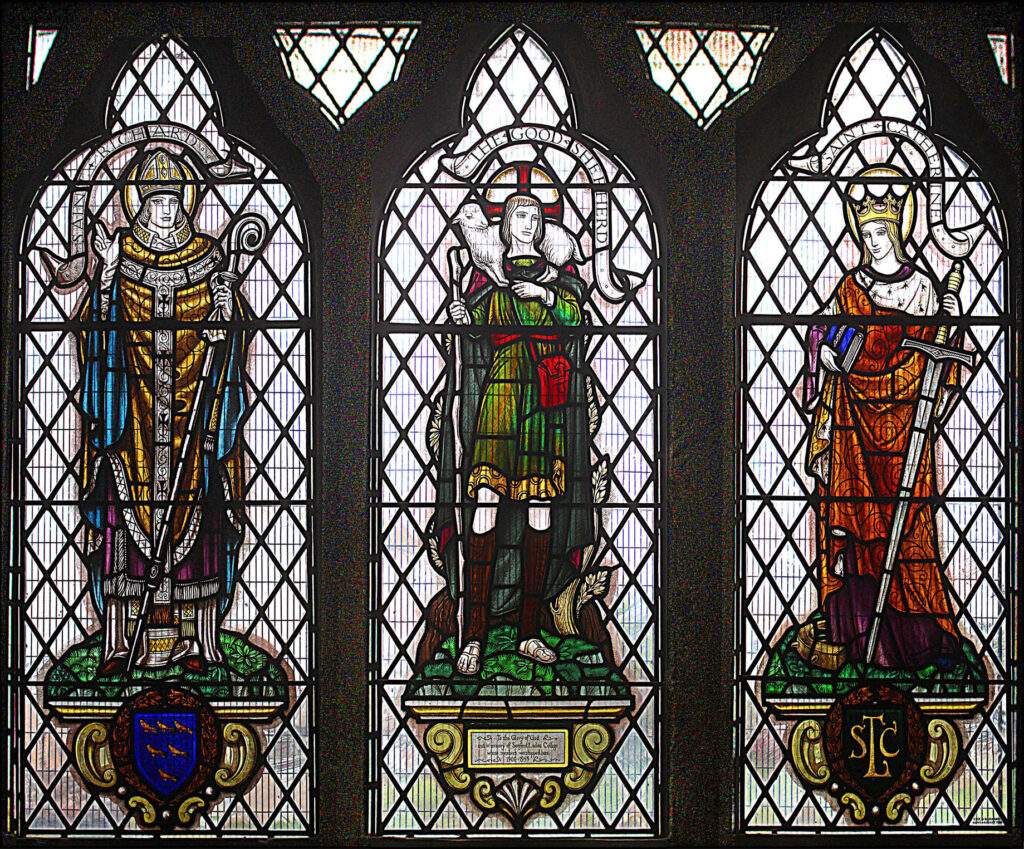
St. Richard; Good Shepherd; St. Catherine.
1954.
By Cox & Barnard (signed).
Memorial to Seaford Ladies College.
Window 4
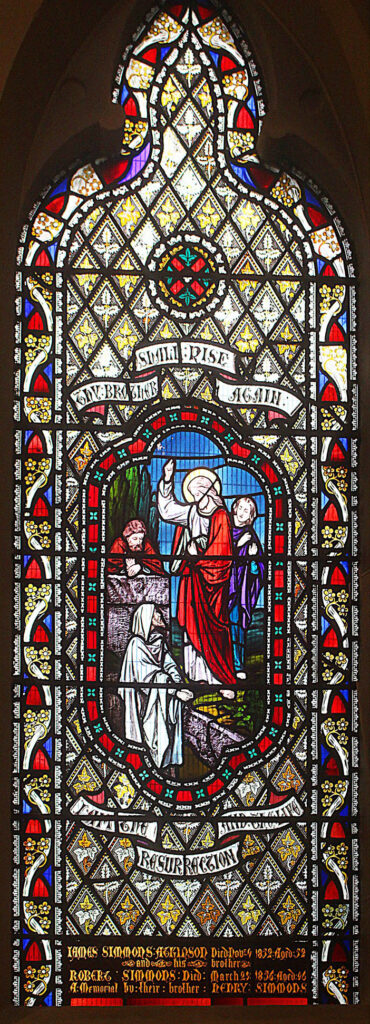
“The Raising of Lazarus.”
1862.
By James Powell & Sons.
Memorial to J Atkinson, Robert Simmons.
The window to the left was destroyed in an air raid on 1st April 1941. It was replaced with plain glass. It depicted ‘The Ascension’.
Window 5
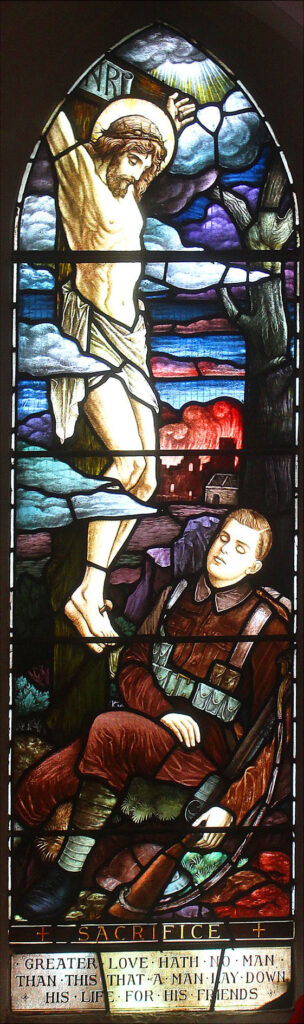
“Sacrifice”.
Crucified Christ looks down at soldier.
1924.
By Heaton, Butler & Bayne (signed).
Memorial to Maurice Galloway +1915.
Window 6
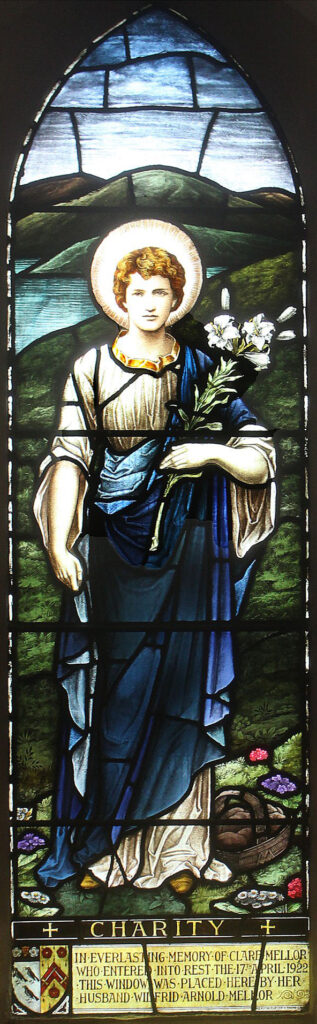
“Charity”.
1924.
By Heaton, Butler & Bayne (signed).
Memorial to Clare Mellor +1922.
Window 7
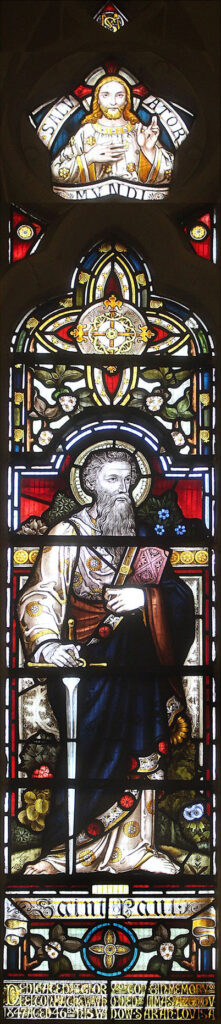
Window 8
“The Sermon on the Mount.”
1862.
By James Powell & Sons.
Memorial to Ann Pierce +1859
Window 9
“Crucifixion,” with the Virgin and St. John.
1862.
By James Powell & Sons.
Memorial to J & C & M Carnegie.
Window 10
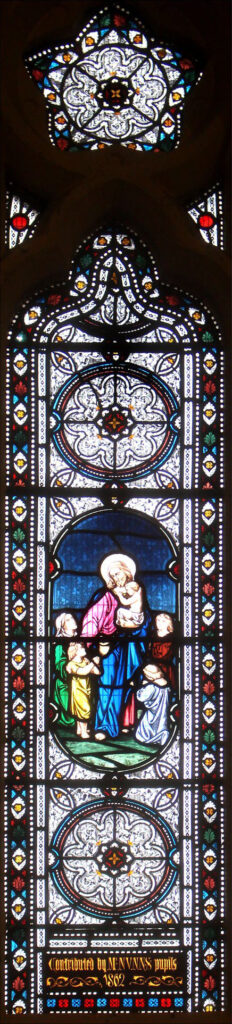
“Christ blessing Little Children,” Contributed by ‘Mr Nunns’ pupils.
1862.
By James Powell & Sons.
Window 11
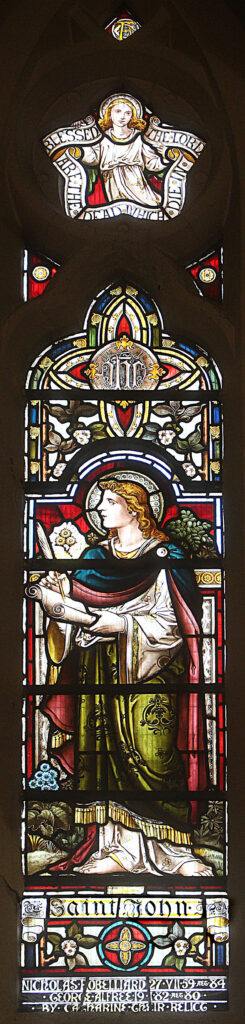
St. John.
1882.
By Gibbs & Howard.
Memorial to Nicholas Robelliard, George Alfree.
Window 12
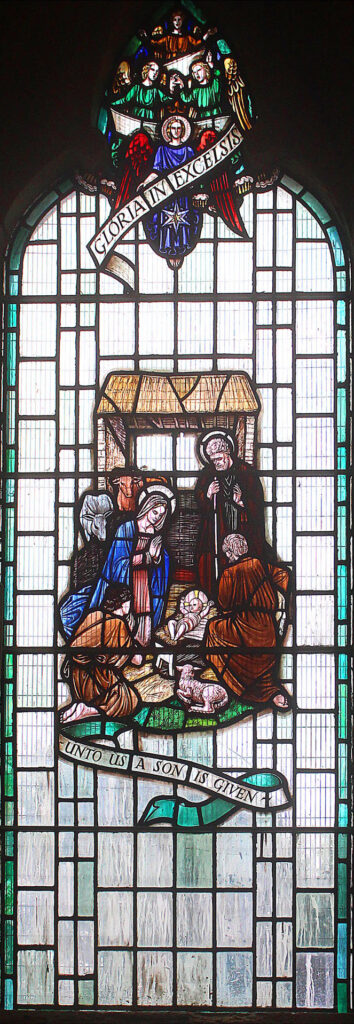
Nativity (with much clear glass).
1958.
By Barton, Kinder & Alderson.
Replaces a window ‘Incidents in the life of Christ’ lost in an air raid on 1st April 1941).
Rose Window

Christ in Majesty & evangelist symbols (Replaces Wailes window of 1864, “The Last Judgement” lost in an air raid on 1st April 1941).
1958.
By Barton, Kinder & Alderson.
Memorial to James Carnegie.
Window 14
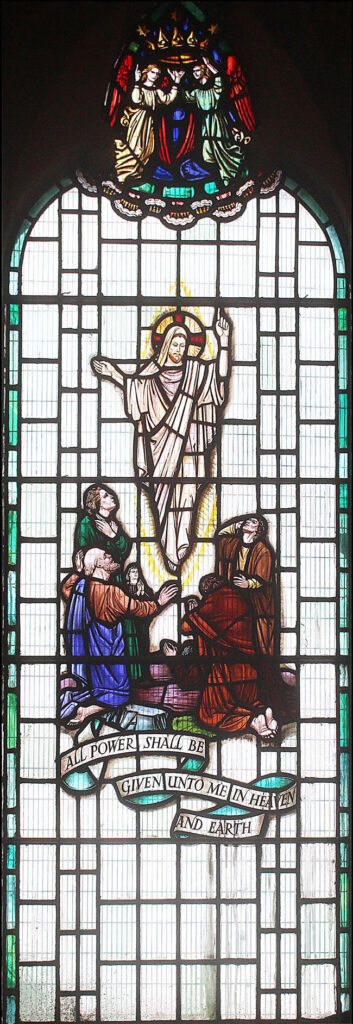
Ascension (with much clear glass) (Replaces Wailes window of 1864, ‘Incidents in the life of Christ’ lost in an air raid on 1st April 1941).
1958.
By Barton, Kinder & Alderson.
Replaces a window ‘Incidents in the life of Christ’ lost in an air raid on 1st April 1941
Window 15
“St. Leonard Confessor; St. Wilfrid the Apostle of Sussex; St. Pancras, Martyr”.
1901.
Kempe (signed).
Memorial to Barclay Brook Head +1901.
The Historied Column
This beautiful piece of carving is some of the most ancient and beautiful in the area. The artist is unknown and unfortunately a lot of his work has eroded, much of it in the last 100 years since heating was installed in the church. We can just about see the bible scenes, which would surely have been referred to by early vicars of the church, to illustrate sermons.
The Rose Window
Christ in Majesty & evangelist symbols (Replaces Wailes window of 1864). 1958. By Barton, Kinder & Alderson. Memorial to James Carnegie.
Ordnance Survey Bench Mark
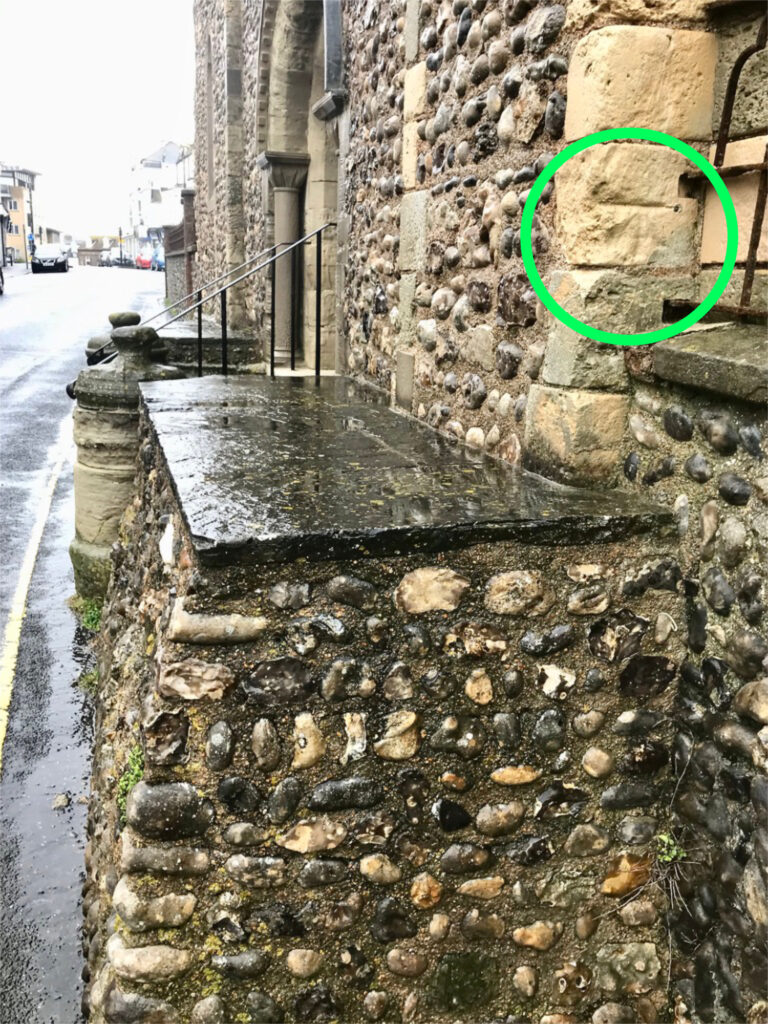
You can see the cut mark (Cut bar with an arrow below), along with a bolt bench mark added at a later date.
Bench marks are the visible remains of height measurements made by the Ordnance Survey. When used in conjunction with older Ordnance Survey maps they indicate the height above sea level at the point of the bench mark. The maps show a bench mark symbol, the letters BM (or B.M.) and the measured height above sea level. Since 1921 all heights are measured relative to a calculated average sea level at Newlyn in Cornwall.
The measurements were made and established around the country by a network of around 190 fundamental bench marks (FBMs). From these FBMs tens of thousands of bench marks were established.
Plaque to remember reordering of 1862
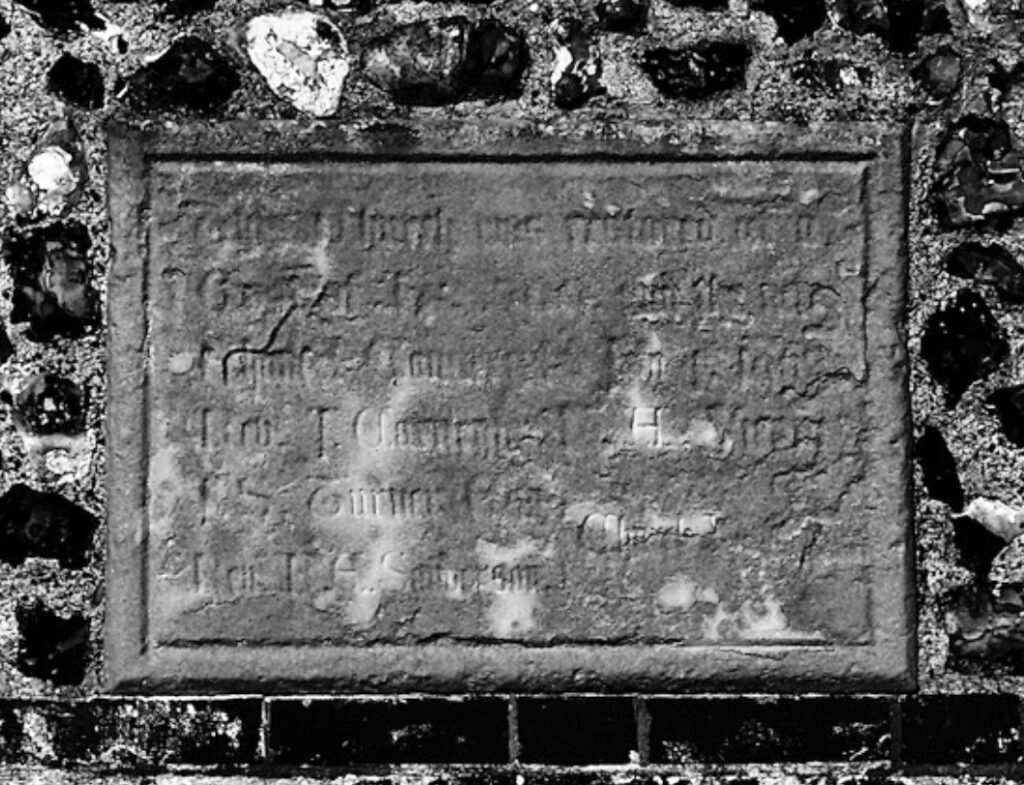
This Church was restored at a
Cost of £2500 and the new
Chancel Consecrated July — 1862
Revd. J. Carnegie M. A. Vicar
J. S. Turner Esq.
Revd. R. E. Sanderson. Church Wardens.
St. Michael
St Michael
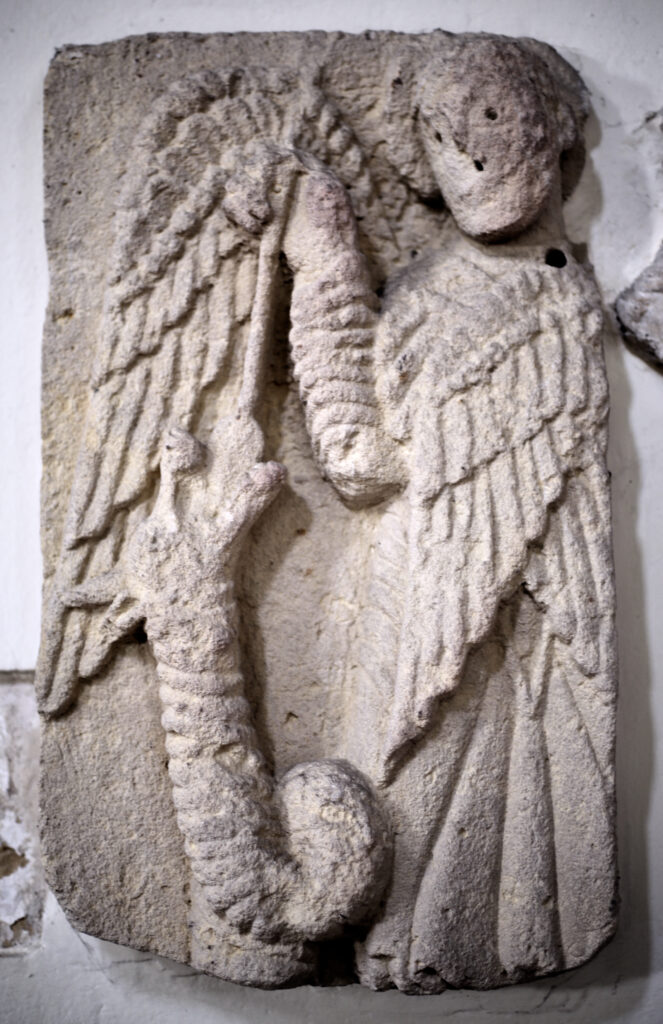
An ancient stone carving has been attached to the north wall of the nave. This depicts St Michael killing a beast. St Michael the Archangel is shown with a halo and wings pushing his sword into the mouth of a serpent; this of course depicts the battle of good over evil. The carving probably dates from the 13th Century and was possibly once placed over the main door to the church.
Rude Corbels
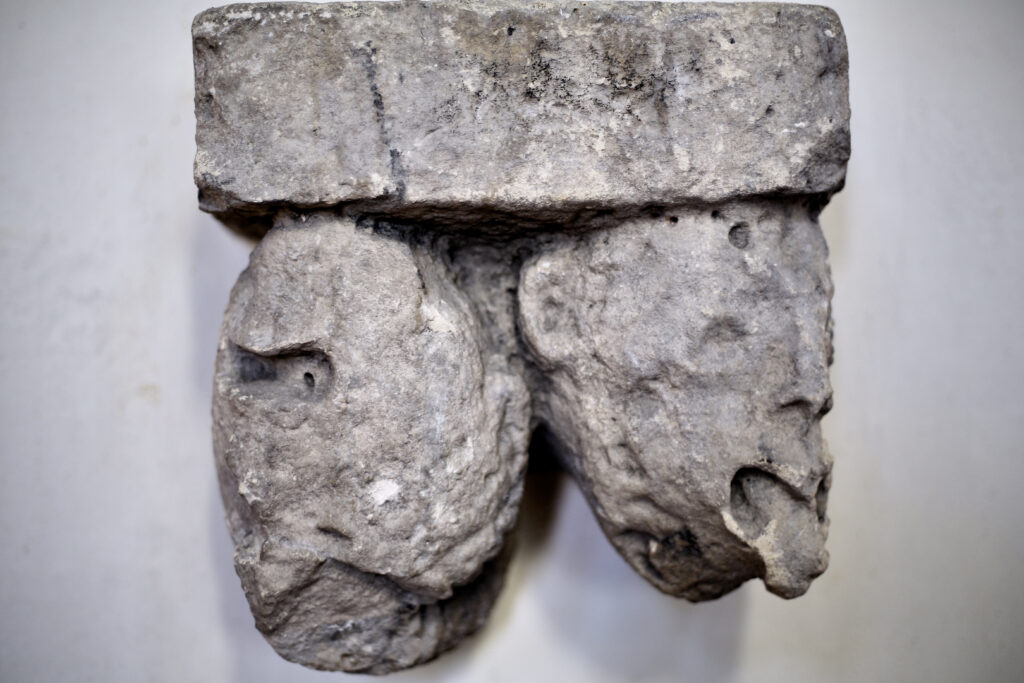
Corbels, some in the form of gargoyles, were placed around the church in the 13th century. During the renovations of 1895, one of these was found built into a doorway on the west side of the church. This corbel is now on display inside, on the south wall of the nave. The face on the left depicts a man with the body of a serpent and with his head upside down. That on the right has his tongue sticking out at the congregation below. One can only wonder what these figures represent and how they fitted into the religious practices of the early church.
Graffiti
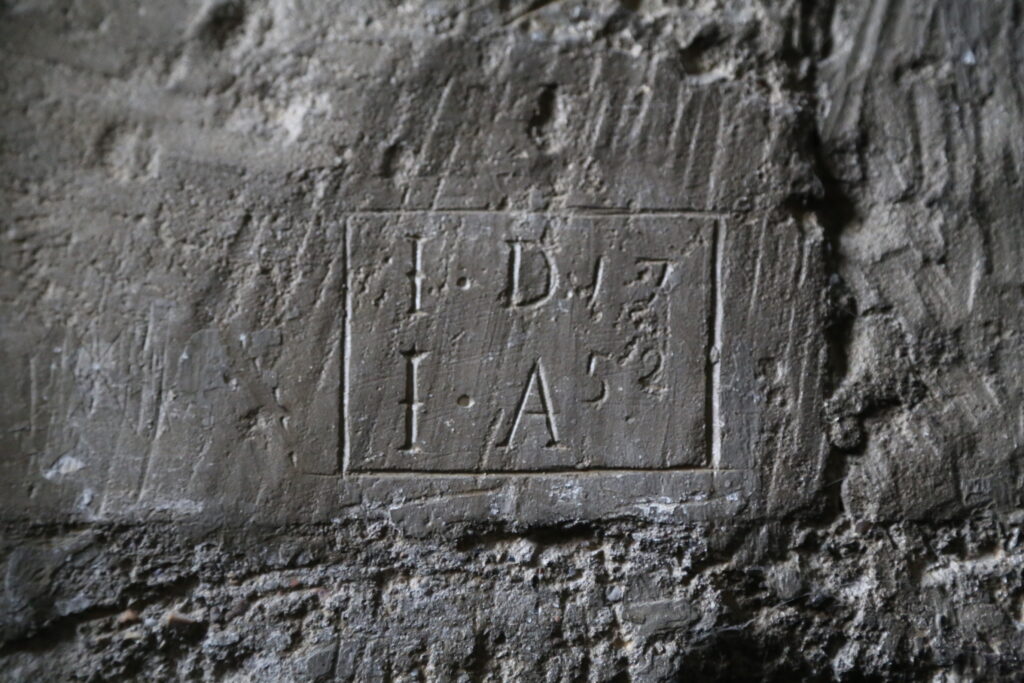
Graffiti is obviously not a new phenomenon, and if you look closely on the wall here, visitors to the church in the eighteenth Century have scratched their initials in the plaster.
Organ Blower Room
This room houses the Organ Blower. It is also where the Elphick Stone is stored.
The Elphick Stone is the oldest surviving memorial inscription at St Leonard’s.
Memorial to Dr. William Pringle Morgan
The Doctor who discovered Dyslexia
There are several brass plaques in the North aisle, but of particular interest is that for Doctor William Pringle Morgan.
Brass memorial to Cuthbert Bromley
Brass memorial to Cuthbert Bromley who was a victim of the First World War.
Pulpit
The oak pulpit was given by the wife of Henry Simmons who was elected Bailiff of Seaford on four occasions. He gave the town “the Simmons Institute” in Crouch lane which was the community centre of its time and also paid for the stained glass window in the Chapel of the Holy Spirit which we will see shortly. The Simmons family go back hundreds of years in Seaford – their name is a corruption of the word ‘seaman’. Many of them are buried in the churchyard near the Lych Gate.
Stone Coffins
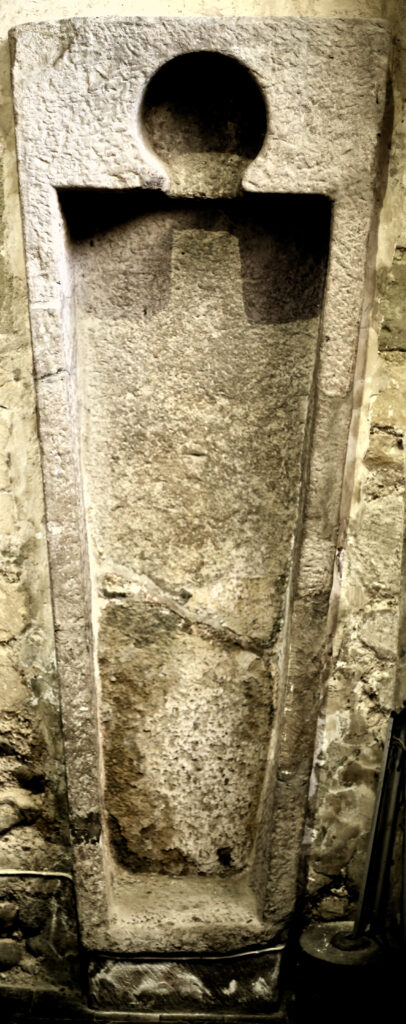
Some stone coffins thought to date from the 13th Century. These were found under the chancel area of the church in 1778, whilst digging up the ancient foundations of the old Chancel, following a fire. Two coffin stones were found at that time, with a third being also found, containing 16 skulls close to the outer wall. Some old church guides have said that these were the graves of Crusaders but there is no evidence for this.
Organ
The introduction of the organ to churches is attributed to Pope Vitalian in the 7th Century. This pope had strong connections with the early Church of England and may have been responsible for introducing the instrument into Britain. The organ is a good complement to the human voice as it can simultaneously provide accompaniment both above and below the vocal register.
Music at our parish church however was initially provided by a few men playing from a gallery at the tower end of the nave. These men would have played the oboe, clarinet and flute. In the early to mid 1800s a small organ was purchased and was initially placed in the gallery; however during the church restorations of 1862 the organ was moved to the south side of the chancel, close to where it is situated today. The Reverend William Henry Mead-Buck was the vicar of Seaford for thirty four years from 1864 until 1898. He was described as a ‘musician of some ability’ and he arranged for a new organ to be built for the church. This organ was made by August Gern (1837-1907) who was a German organ-maker who had trained in Paris (although at this time he was living in Notting Hill in London.) This new organ was purchased by public subscription at a cost of nearly £230 although £30 was made on the sale of the old organ. The new organ had 2 manuals, 11 stops and 3 couplers and was first used in public on 18th August 1875 when it was played by the organist from Brighton College, Mr Robert Taylor.
This fine organ was used for over 30 years but was quite small and powered by a hand pump so about 100 years ago it was decided that a modern organ should be purchased. The contract was given to a local company from Brighton, Morgan & Smith who supplied many local organs and went on to build many of these fine instruments. They supplied a larger organ with 2 manuals, 24 stops and 5 couplers which was powered by a ‘hydraulic blowing plant with tubular pneumatic action.’ This organ was purchased at a cost of £500 and presented by Mr and Mrs James Burroughes, who lived in Cricketfield Road. Mr Burroughes had made his money from making snooker equipment and it was he who also sponsored Seaford’s first Boy Scout packs. The old organ was not sold but donated to Seaford Baptist Church.
Although the new organ was first used in July 1909, the blowing plant caused problems and had to be replaced in 1927 and again in 1935 when an electric Duplex Organ Blower was introduced. The organ was rebuilt in 1965 and the opening recital was by Dr Francis Jackson the organist from York Minster.
It was again cleaned and overhauled in 1989 and in 2002 a new trumpet stop was added which took the number of organ pipes at Seaford Parish Church to 1,620.
Today the organ at St Leonard’s is still providing the sterling service for the congregation. John Baker has been the organist since 1990 when he replaced Brian Richards who had served in the position from 1958 until his death in 1989.
Altar
Whilst the existing ‘High Altar’ remains untouched, a new ‘forward’ Altar is now in use. This can be moved aside as and when required.
Font
New ‘Mobile Font’ installed at the same time as the ‘Forward Altar’.
Paschal Candle
The Paschal candle remains in the Sanctuary on its special candle stand during the full 50 days of the Easter season, and is lit for liturgical services during that time. After Pentecost the candle will be placed next to the baptismal font. The candle is lit during all baptisms throughout the year, passing the light of Christ to each person baptized, starting with the Catechumens at the Easter Vigil service. The candle may also be used at funeral services, and placed next to the casket during a funeral Mass. At funeral services it is a reminder that the sacrament of Baptism is itself a death and resurrection in Christ, and testifies to Christian certainty in the resurrection of the dead and life with Christ in the world to come.
Bells
There are Eight Bells within the Tower.
Clock Weights Cupboard
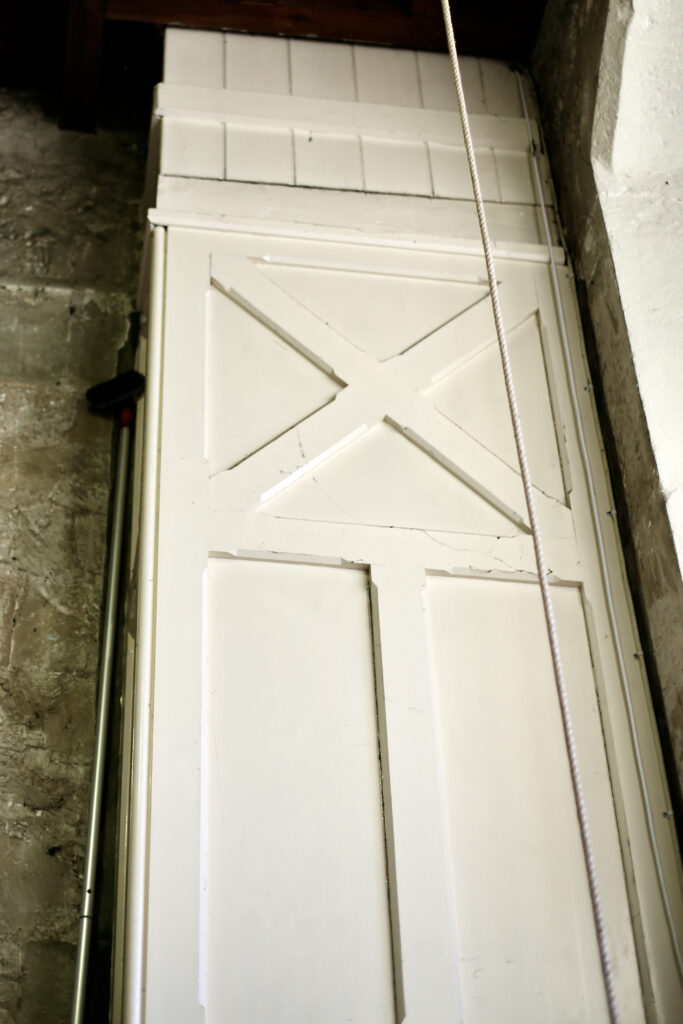
Here, the Clock weights used to be pulled up every week, before an electric motor was installed.
The Clock has three faces (South, West and North). The current clock dates from 1886.
Norman Arch
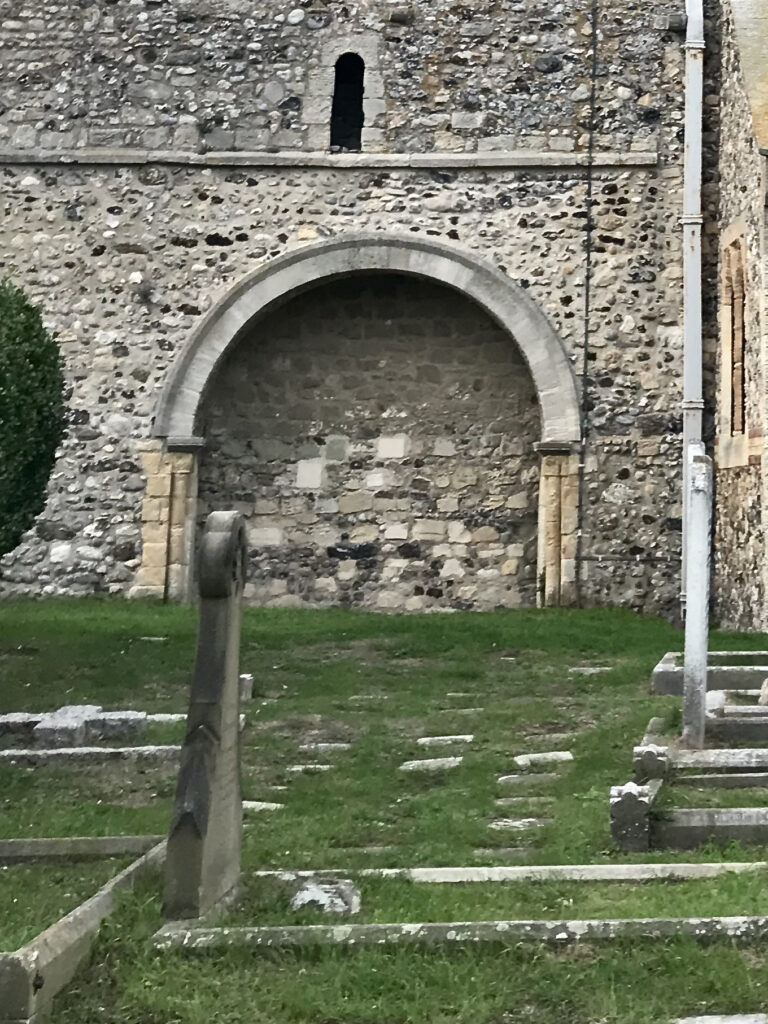
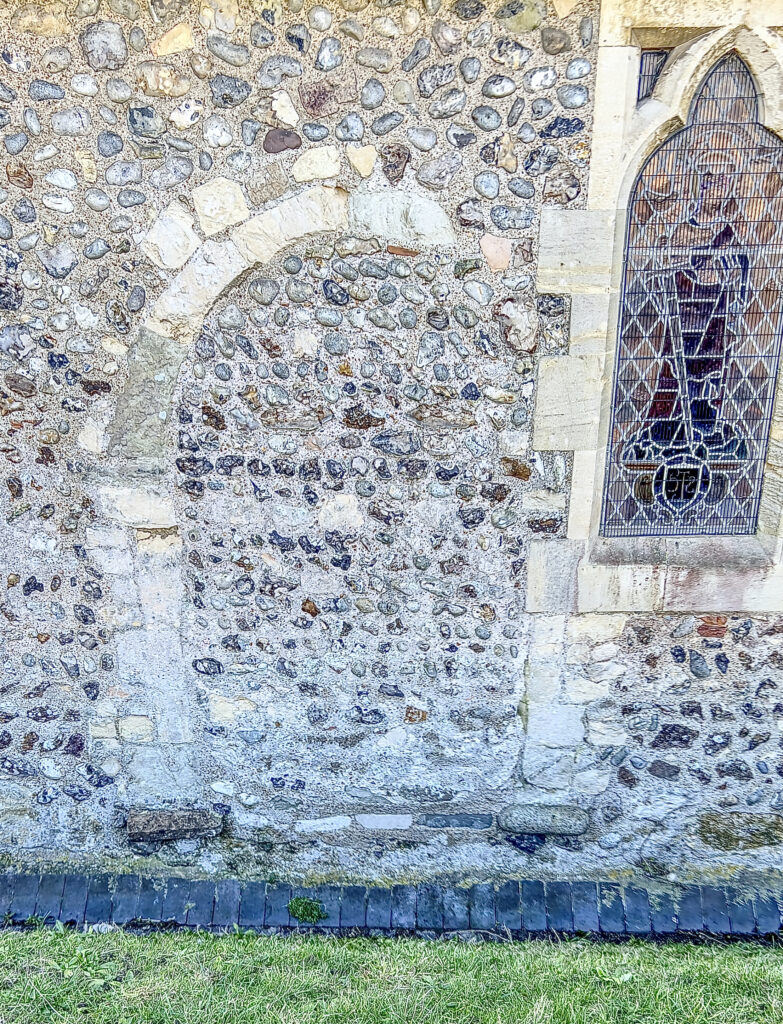
In the early life of the Church, it was found necessary to expand the Structure further, and two aisles were constructed either side of the nave. At this time, three rounded Norman arches were cut into the walls on each side, but today only two of these remain; one in the Choir Vestry, and the other open to the South side of the Tower.
Blocked up Doorway
Hurdis Family Crypt
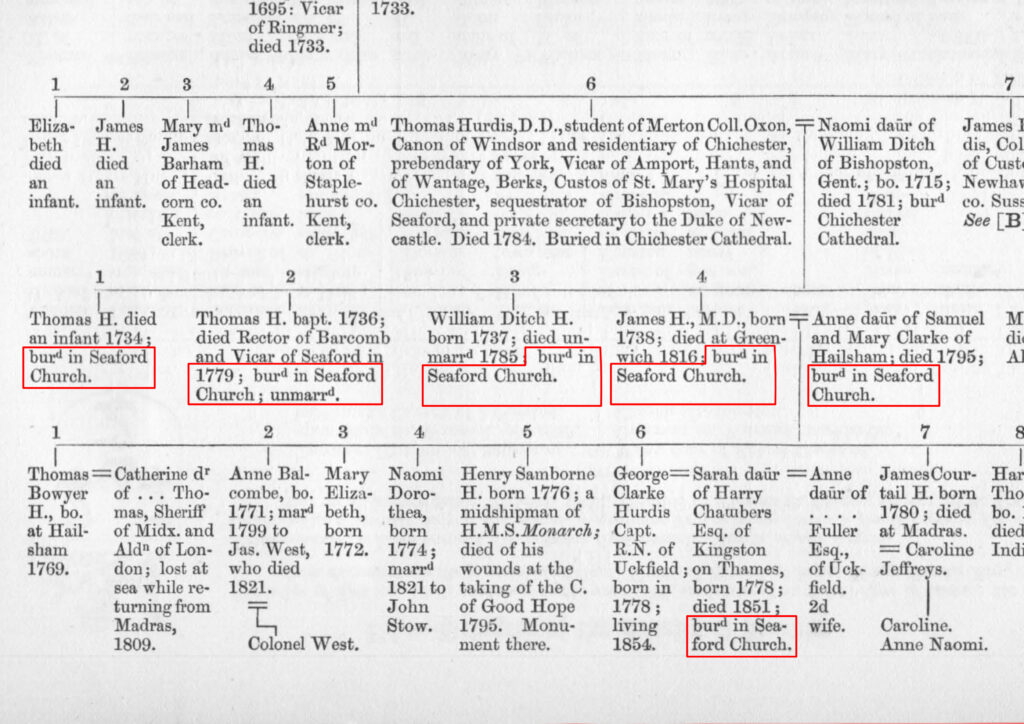
In October 2006, an Archaeological Monitoring session was carried out on the Church floor, where trenches for the new flooring supports opened up voids below. No other voids were sought at that time, other than the Five noted in the Nave. The Carnegie Vault has been marked, as this location is well known from Parish records.
A Tablet on the North wall of the Tower refers,
this tablet was moved in the re-ordering of 1861.
Hurdis
In the centre aisle of this church, are deposited the remains of
the three sons of Thomas Hurdis, D.D. Canon of Windsor,
and Canon-residentiary of Chichester, and Naomi his wife.
THOMAS, A.M. formerly Vicar of this Parish and of
Barcombe, in this County; who died a bachelor, A.D. 1779.
WILLIAM DITCH, who died a bachelor, A.D. 1785.
JAMES, M.D., who died 8th October 1816, aged 77 years;
and ANN, his wife, youngest daughter of Samuel Clarke,
of Hailsham; who died 3rd January 1795, aged 48 years.
This tablet is designed to perpetuate their memory,
and the memory of THOMAS BOWYER, eldest son
of James and Ann Hurdis, a senior Merchant in the service
of the honble East India Company, and one of the Judges
of the Sudder Court, at Fort St George; who died there
16th November 1808, aged 38 years;
CATHERINE, his widow, a daughter of Nathaniel Thomas,
an Alderman of the City of London, who was lost at Sea, on her
return from India, in 1809:
HENRY SAMBORNE, their 2nd son,
a Midshipman in the Royal Navy;
who after the taking of the Cape of Good Hope, died
at Cape Town, 6th November 1795, aged 19 years:
JAMES COURTAIL, their 4th son, a Captain in the
2nd bat n 19th regt of the honble East India Native Infantry,
who died at Cannanore 16th August 1819, aged 38 years:
and HARRIOT THOMAS, their 4th daughter, who died
at Dindigul, in the East Indies, 9th May 1802, aged 19 years.
The trumpet shall sound, and the dead shall be raised incorruptible. 1 Cor.XV.52
Thomas A M Hurdis was curate of Seaford 1759-1772 but never Vicar, and died
in 1778 not 1779 (Parish Records). ]
Small Crypt containing Child
In October 2006, an ArchaeologicalMonitoring session was carried out on the Church floor, where trenches for the new flooring supports opened up voids below. No other voids were sought at that time, other than the Five noted in the Nave. The Carnegie Vault has been marked, as this location is well known from Parish records.
As this crypt is small in dimension,
and clearly contains a small ‘Childs’ remains,
it is possibly the resting place of:-
“Here Lyeth the Daughter of Henry Bill,
and Latitia, his wife, being still-born,
August 21st 1676.”
Taken from a Gravestone found,
during the Re-ordering of 1861
or:-
Another Gravestone found at the time reads,
“Here lyeth interred the body of Latitia,
wife of Henry Bill,
daughter to the Honourable Sir James Colbrond, Bart.,
who departed this life, August 23rd AD 1676″
or:-
Another Gravestone found at the time reads,
‘Thomas, son of the Rev. Thomas Hurdis, D.D. (Vicar of this Parish),
and Naomi, his wife, who was buried June 21st 1734, aged 16 days.”
Another Gravestone found nearby reads,
‘Beneath this stone are deposited the remains
of the Rev. Thomas Evans,
who was upwards of thirty-eight years
Vicar of this Parish,
and died October 1st 1815, aged 66 years.”
Crypt under Floor
In October 2006, an ArchaeologicalMonitoring session was carried out on the Church floor, where trenches for the new flooring supports opened up voids below. No other voids were sought at that time, other than the Five noted in the Nave. The Carnegie Vault has been marked, as this location is well known from Parish records.
Possibly the resting place of,
“Elizabeth, daughter of Alexander Champion,
of Walthamstow, Essex,
who died 31st August 1784, aged 16 years.”
Inscription found on a gravestone nearby.
Old heating duct under floor
In October 2006, an ArchaeologicalMonitoring session was carried out on the Church floor, where trenches for the new flooring supports opened up voids below. No other voids were sought at that time, other than the Five noted in the Nave. The Carnegie Vault has been marked, as this location is well known from Parish records.
This void appears to be a backfilled heating duct, filled with degraded wood.
No human remains or coffin remnants were observed, and the internal walls were covered with soot.
Past inscriptions found before the Re-ordering of 1861, refer to the Elphick and Harison families, “formerly IN Seaford church,” and it is generally considered that these (and probably some others), were removed when the present Chancel was built. A broken Elphick stone was found during the Re-ordering of 2006, and has been subsequently stored in the Organ Blower room, to keep it safe.
Burial under floor
In October 2006, an ArchaeologicalMonitoring session was carried out on the Church floor, where trenches for the new flooring supports opened up voids below. No other voids were sought at that time, other than the Five noted in the Nave. The Carnegie Vault has been marked, as this location is well known from Parish records.
Atkin
Anno 1807
Beneath lie the Mortal remains of
ESTHER
the Wife of Geo. ATKIN Esqr.
Paymaster of the 2nd Somerset Militia
who paid the Debt to Nature
in the Meridian of her Day
and to whose Memory this Tablet is
erected by a fond and Afflicted
Husband
Obt. 15th April Aet. 31.
Carnegie Family Vault
A Tablet on the North wall of the Tower refers,
this tablet was moved in the re-ordering of 1861.
In the Vault Beneath are deposited the Remains of
Colonel JOHN CARNEGIE,
Formerly of the 11th Regt of Light Dragoons, and
Son of the late
Sir James Carnegie, of Southesk Bart.
who died Septr 29th 1823, Aged 67 Years.
Also of
CATHERINE his Wife
who died Decr 25th, 1824, Aged 71 Years
Also of
MARY Eldest Daughter
of the said Sir James Carnegie,
who died Febry 6th 1828, Aged 67 Years.
Site of old heating unit
This area, below ground, has been where the heating supplies throughout the ages were located. Todays heating system is now at Ground Level.
Plain Glass Window
This Window was destroyed by an Air Raid in WW2.
The original window was ‘The Ascension’ in memory of “Chas Hincks, 24th November 1813, by his widow”
Church Mouse
You will have heard the phrase ‘As quiet as a Church Mouse’, well, here he is.
Oak Screen
The oak screen between the Chancel and the North Chapel, was completed in 1950 as a memorial to the Rev. C. H. Maxwell. At the time of his death in 1947, it was difficult to obtain suitable timber or qualified craftsmen, and still more difficult to obtain an estimate of the cost. The initial estimate of £150 – £200, grew to £463 upon completion in January 1950.